Parivarik ManuRanjan (2026): Pankaj Tripathi Anchors a Mansion-Sized Muddle

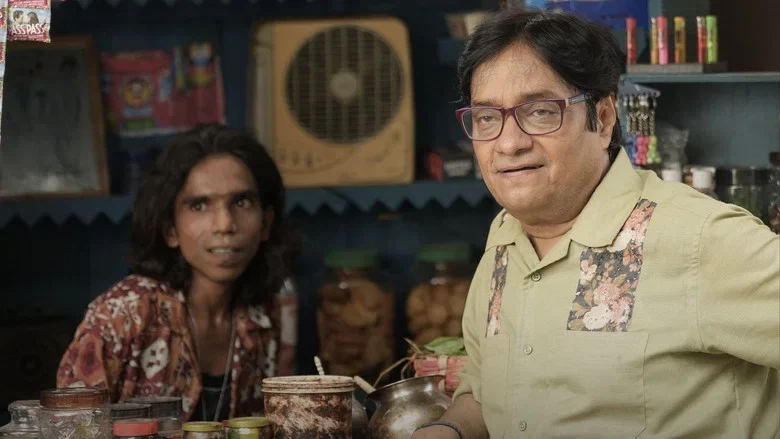
Varun V. Sharma opens on empty rooms: a Lucknow ancestral mansion with too many doors and one occupant. Pankaj Tripathi’s Ranjan Dubey has inherited the square footage but not the life to fill it.
That image, inherited space outlasting inherited purpose, is the film’s best idea. Everything afterward fights to live up to it.
A Bachelor’s Solitude Is a Comic Engine Until It Becomes a Waiting Room
The first stretch sets its terms cleanly. Brijendra Kala’s well-wisher shuffles through matchmaking schemes with the fussy persistence of a man solving someone else’s problem, and Ranjan absorbs each attempt with the flat courtesy of a host who wants the guests gone.
Tripathi plays the pressure inward. His Ranjan doesn’t rage against his unmarried status; he simply occupies it, moving through corridors with the unhurried ownership of a man who has stopped expecting the doorbell to change anything.
Then Aditi Rao Hydari’s Helen arrives as a hired property manager, not a bride. That single structural decision is the screenplay’s sharpest move, a woman enters the house with a contract instead of a proposal, and the comedy shifts from matchmaking farce to something thornier about labour, dependence, and who gets to define a household.
When the Conflict Is Diffuse, the Middle Act Has Nowhere to Push
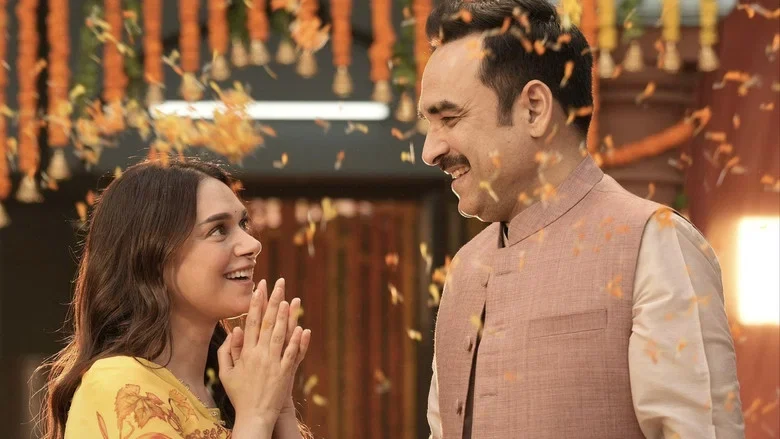
The problem is that the film never converts its social pressure into narrative escalation. Prejudice and marriage expectation are real obstacles, but they arrive as ambient disapproval rather than as a mechanism that tightens scene by scene.
Sharma’s screenplay, co-written with Kala and Ali Abbas Zafar, keeps circling the same domestic routines, tea, errands, shared corridors, without letting any single encounter permanently alter the arrangement. The result is a middle stretch that drifts where it should accumulate.
Compare the discipline on display in Bouma, where a contained premise is forced to generate its own momentum because the walls won’t let the characters leave. Here the mansion is generous enough to absorb the tension instead of concentrating it.
Tripathi’s Stillness Against Rao Hydari’s Guarded Professional Warmth
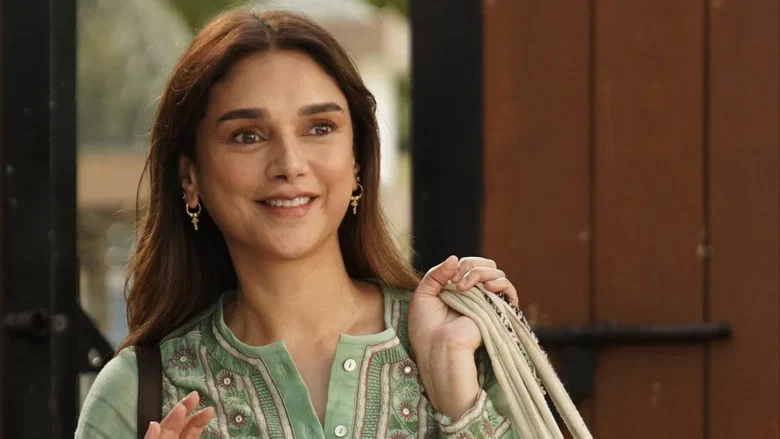
What holds the frame is the physical contrast between the two leads. Tripathi works in lowered registers, a stalled hand, a gaze that slides away mid-sentence, the shoulders of a man who has learned to take up less space than his house allows.
Rao Hydari counters with a brisk, upright competence. Watch how Helen sets down a tray or corrects a household detail: her posture stays professional even as her attention lingers a beat past the task, and that tiny overhang is where the romance actually lives.
The script asks Tripathi to travel from resigned solitude to something like acceptance, and he does it in increments rather than declarations. The weariness he carries into the final domestic scenes has the same quality as his finest work in Mirzapur, authority expressed through economy, never volume.
Kala, meanwhile, is the film’s connective tissue, forever arriving at the wrong moment with the right intentions. It’s a generous supporting turn that keeps the social world from flattening into set dressing.
A House Shot Like a Character, and a Score That Won’t Stop Explaining It
The visual approach is patient to a fault. Sharma favours wide compositions that let the mansion’s corridors dwarf his protagonist, and the staging repeatedly places Ranjan at the far end of a room with Helen in the foreground, spatial grammar for a man watching his own life from a distance.
But the film rarely trusts those frames. Where a held silence would do the work, the soundtrack arrives to clarify the mood, and the editing keeps cutting away from moments that had earned the right to breathe.
This is a recurring tension in contemporary Hindi comedies, which increasingly mistake warmth for constant reassurance. A film this quiet doesn’t need to keep telling us it’s tender.
The Ending Resolves the Relationship and Dodges the Question Beneath It
The climax moves toward recognition, the relationship acknowledged, the household redefined, the social disapproval absorbed rather than defeated. It’s a resolution built on emotional legitimacy rather than confrontation, which is coherent with everything the film has set up.
What it avoids is the harder question the premise raises. If Helen’s position in the house began as employment, the film never fully sits with what it means for her dignity to be settled through Ranjan’s emotional awakening rather than her own leverage.
That evasion is exactly the gap that separates this from a sharper social romantic comedy like Pehla Pyaar Doosri Baar, which at least lets its central pair collide over what they each want rather than settling for what the house requires.
Bhanushali and AAZ Films Bet on Streaming, and the Bet Is Legible
This is a Sony LIV premiere rather than a theatrical proposition, and the economics explain the shape of the thing. Bhanushali Studios and Ali Abbas Zafar’s AAZ Films have built a contained, star-led relationship comedy with one location and two marquee names, a low-risk asset designed for platform acquisition rather than exhibition muscle.
For Tripathi, that’s a meaningful data point. His theatrical leverage now rests on films that sell tension and event; this one sells familiarity, and familiarity is a streaming currency, not a box-office one.
The wider franchise logic is worth flagging too. As the remake pipeline and the mid-budget theatrical rom-com both cool, the ancestral-mansion comedy becomes a platform staple, cheap to mount, easy to market on casting, and structurally insulated from opening-weekend verdicts.
The Verdict
Parivarik ManuRanjan is a film with a genuinely interesting premise and insufficient pressure to test it. The pairing works, the house works, and Tripathi’s refusal to perform his loneliness works best of all.
But a romance built on unequal ground needs to interrogate that ground, and this one prefers to decorate it. What lingers is not the resolution but the image it opens with: a man alone in a house too large for him, waiting for someone to arrive with a reason to stay.
The film gives him one. It just never quite asks whether she was owed something more than a home.
Explore Cinema Hubs

Recommended for You

THE BRANDOS (2026): A Phantom Release That Never Was + A Void Where Cinema Should Be
The ticket stub in my pocket says “The Brandos, ” but the screen that flickered to life at the 7:40 show carried…
Sudesha (2026): A 35-Minute Portrait of Chipko Resistance That Stays Earnest, Uneven
The village women carry firewood and water while the men argue about timber contracts, and Sudesha Devi moves between both worlds, a…

Bhai Tera Star Hai (2026): A Familiar Bollywood Fantasy for Raghav Juyal’s Fans
Raghav Juyal stands in a London casting room, claiming he has landed a role in a star-franchise parody called “Kisi Ka Bhai,…