Melcow Pondicherry (2026): Arjun Ashokan’s Reunion Comedy Turns Survival Thriller in a Debut That Bites Off More Than It Chews

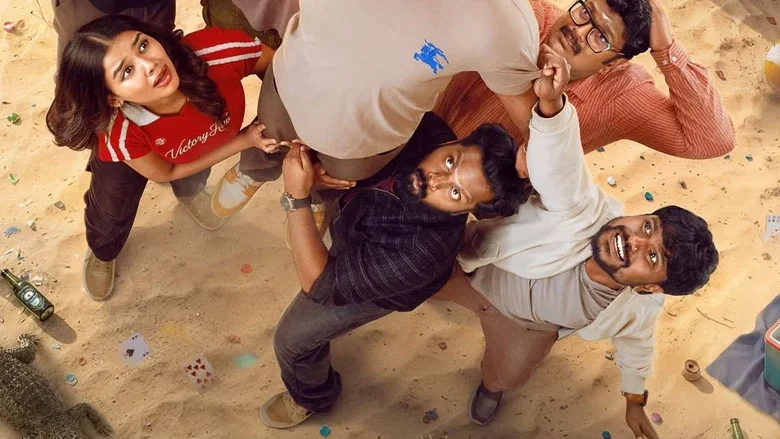
The bachelor party starts as a toast to old times and ends as a scramble for the exit. Nikhil Mohan’s debut wants to be two movies at once, and only one of them has a pulse.
A Reunion Comedy That Forgets the Laughs Are Load-Bearing
The premise is seductive on paper: a pack of expelled college friends, years removed from the institutional shame that bound them, reconvene in Pondicherry for a wedding-adjacent bacchanal. The film opens with the easy, loose-limbed camaraderie of men who have rehearsed their old jokes so many times the punchlines arrive before the setups.
That comfort is the point. Mohan and writer Sanoop Thykoodam spend their first act building a warm, beer-soaked fraternity of arrested adolescents, and for a while the ensemble’s rhythm carries the material. Then the buried secrets surface, the tone shifts, and the movie discovers it has no idea how to be scary.
When the Thriller Turn Arrives, the Tension Never Does
The transition from celebration to danger is the film’s entire gamble, and it is the first place the seams show. The former college becomes a site of threat, which is a smart geographic idea, nostalgia weaponized, the familiar corridor turned hostile.
But the staging stays oddly airless. Mohan favors wide, flat compositions that keep the group bunched together in the frame, so when the danger escalates there is no spatial language for pursuit, concealment, or escape.
Compare the tighter spatial discipline on display in John Doe, where the camera’s claustrophobia did the work the script couldn’t, and this film’s refusal to close the distance feels like a missed instinct rather than a stylistic choice.
Arjun Ashokan Holds the Center While the Ensemble Drifts
Ashokan is the gravitational pull here, and he is most alive in the quiet moments between the set pieces. Watch him in a mid-film beat where the group’s banter curdles: he goes still, drops his voice a register, and lets his eyes do the arithmetic of a man realizing his friends are now liabilities.
That register of exhausted, cornered restraint is the same instrument he deployed to sharper effect in Disco. The difference is that this screenplay never gives him a decision worth that stillness, he reacts, he runs, he survives, but the film never asks him to choose.
Of the supporting players, only Rajendran registers with any real texture, and he does it through sheer physical presence: a slow, deliberate walk into frame that momentarily suggests the movie has found a pulse. Balu Varghese and Althaf Salim are stranded as comic furniture, their characters interchangeable when the plot needs a body to panic.
The Secret Is the Villain, and the Secret Is a Void
There is no antagonist to speak of, which is a defensible choice, the past itself is meant to be the threat. But a thriller needs a face, or at least a mechanism, and this one keeps the mystery so abstract that the audience has nothing to fear but a vague sense of foreboding.
The screenplay treats its buried secret as a reveal to be withheld rather than a pressure to be applied.
Contemporary Malayalam thrillers have learned that dread is a texture, not a plot point, and the more disciplined ones, the kind of suffocating, character-first dread that powered Bouma, understand that the audience must feel the secret before they learn it.
Electronic Kili’s Score Does the Heavy Lifting the Camera Won’t
If the visual grammar is inert, the sound design is at least trying. Electronic Kili’s score leans on low, sustained drones during the second-half escalation, and there are stretches where the music is doing all the emotional work the blocking refuses to do.
That is a backhanded compliment. When a score has to manufacture tension the images cannot generate, the film has outsourced its own suspense. A late sequence in an enclosed corridor finally gets the framing right, tight, sweaty, faces filling the frame, and for about ninety seconds the movie becomes the thriller it promised.
The Commercial Math on a Debut That Plays It Safe
Arun Gopy Excitements and Justin & Mathew Entertainments are backing a first-time director with a recognizable young ensemble, which is a low-ceiling, moderate-floor bet. Ashokan has built genuine theatrical goodwill in the youth-comedy space, and his name will open this film in Kerala without carrying it much further.
The wider exhibition question is whether the reunion-comedy-to-survival-thriller pivot has a sustainable audience. It is a familiar hybrid in contemporary Malayalam thrillers, and this one does not do enough with the formula to break out of its regional lane.
The Uncomfortable Resolution: A Survival Story With Nothing to Survive For
The ending resolves around escape, which is the least interesting thing a film about buried guilt can do. The friends get out, the past stays roughly where it was, and the movie’s central question, what do you owe the people who were complicit in your worst moment, dissolves into a chase sequence.
Melcow Pondicherry is a debut with a genuinely good idea and an execution that keeps apologizing for it. The bachelor party is fun. The thriller is a rumor. And somewhere in the gap between them is the movie Mohan might make next, once he trusts his own darkness enough to let it breathe.
Explore Cinema Hubs

Recommended for You
Shabara (2026): Dheekshith Shetty Digs Into A Dual-Era Treasure Hunt That The Evidence Can’t Yet Cash
Two eras. One treasure. That’s the whole pitch, and Kilaru Prem Chand’s directorial debut is smart enough to know that a logline…
Sanjeev (2026): Anil Nakka’s One-Man Gamble on Grit and Grief
There is a particular kind of tension that arrives when a filmmaker steps in front of his own camera, and Anil Nakka’s…
Mother Promise (2026): Dhananjaya Anchors A Chaotic Kannada Comedy-Thriller
A hapless gambler (Dhananjaya) sprints through a fictional Bengaluru, dodging debt and two powerful dons, when his mother (Vinaya Prasad) suddenly joins…