John Doe (2026): Arjun Das Anchors a Procedural That Buries Its Own Best Instincts


Madhumita Sundararaman opens on a dead child with no name and a living one who has just vanished, and for a while the film believes in the terror of that symmetry.
Then it starts explaining itself, and the spell breaks.
Two Files, One Wound, And A Director Who Trusts Her Own Silence
Chandru’s father is a policeman who told his son he would never wear the uniform. That line lands early, and the film keeps returning to it like a tongue to a chipped tooth.
The early investigative blunder that lets a criminal walk is staged with real discomfort, no music cue to reassure us, just a man realising his error a beat too late.
What follows is an unidentified boy on a slab and, in a hill station across the border, a sister who takes her little brother for ice cream and comes back alone.
Sundararaman’s smartest structural move is refusing to let these be separate films. The John Doe inquiry and the missing-child complaint converge, and the convergence is where the picture briefly becomes something leaner and meaner than its marketing suggests.
There is a spatial discipline here that recalls the claustrophobic domestic pressure of Parivarik ManuRanjan, though this film has the better engine under its hood.
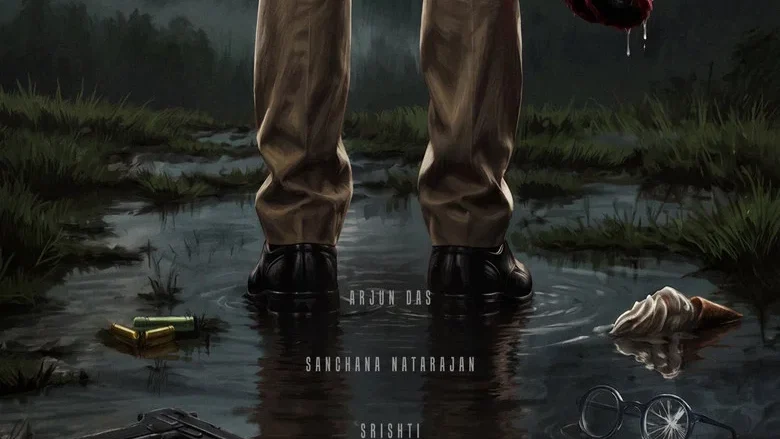
Arjun Das Plays Two Men In One Skin, And Only One Of Them Is Written
Arjun Das has spent his career weaponising stillness, the lowered voice, the eyes that arrive somewhere before the rest of his face does.
He brings that same coiled restraint to the interrogation rooms here, and the physical exhaustion he carries into the film’s back half recalls the bruised interiority of his work in Once More.
The problem is that Chandru’s trauma is asserted more than dramatised. We are told the father was abusive; we rarely sit inside the memory long enough to feel it.
Sanchana Natarajan’s A Rao is the film’s most interesting presence precisely because she is given so little psychology to announce. She works a case, shares a desk, and lets her competence do the talking.
Badava Gopi, as the father, gets one devastating register, the flat, unbothered certainty of a man who has already decided his son’s ceiling, and the film wisely doesn’t give him a redemption arc.
The Trafficking Reveal Expands The Stakes And Shrinks The Movie
When the investigation widens from one missing boy to a network, the film gains scale and loses intimacy in the same breath.
A single child’s disappearance is terrifying. A racket is a plot device, and the screenplay starts treating it like one, moving bodies around to service the next procedural beat.
The culprit is eventually tracked and confesses, and the confession is delivered with a shrug the film mistakes for menace.
What’s missing is the suffocating dread that a thriller like Scene understood instinctively, that the best tension comes from what a character refuses to say, not from what the plot needs him to confess.
Here, information arrives on schedule. Every clue lands where the audience expects it, and the second half starts feeling less like an investigation and more like a checklist being ticked.
A Camera That Watches, A Score That Won’t Shut Up
The border-town geography is the film’s strongest visual asset, wet streets, hill-station fog, the specific grey of a police station at dawn.
Sundararaman frames her investigator in medium shot, often from behind, so we watch him think rather than watch him perform thinking. It’s a modest choice, and it works.
Then the background score arrives to tell us how to feel about every single one of those moments, and the modesty evaporates.
There’s a sequence in the middle stretch, a quiet exchange between Chandru and A Rao at a desk, no music, just two people failing to comfort each other, that hints at the film this could have been.
It’s over in ninety seconds, and the strings come back, and we’re off to the next plot point.
The Studio Bet, The Remake Pipeline, And What Arjun Das Is Actually Worth At The Box Office
This is a limited theatrical release with no verified budget transparency, which in the current exhibition climate is its own kind of statement.
The producing banner is betting on the Tamil psychological-thriller lane that has quietly become one of the more reliable mid-budget corridors in contemporary Tamil thrillers.
Arjun Das remains a genuine theatrical draw in that corridor, his name on a poster still moves a specific, loyal audience, but he has yet to headline a film that fully converts that goodwill into a breakout number.
The remake-and-adaptation pipeline that sustains so much of this slate is starting to show fatigue, and original IP like this one is the obvious corrective. Whether the market rewards the correction is a different question.
The Ending Resolves The Case And Quietly Abandons The Man
Chandru gets his confession, gets his closure, gets the professional vindication his father denied him. The film treats this as a victory.
But the question the synopsis keeps asking, am I good enough?, is answered by an arrest, which is not an answer at all. It’s a plot resolution wearing a character arc’s clothes.
What lingers is not the trafficking bust or the confession, but the earlier image of a sister standing in a police station describing an ice-cream parlour she will never be able to think about again.
That’s the film Sundararaman almost made. The one we got is competent, watchable, and strangely bloodless, a thriller that identifies its own best instincts and then files them under evidence.
Explore Cinema Hubs

Recommended for You

Varavu (2026): Joju George s stands out while the narrative loses grip
Joju George enters a hillside town where power has long crushed whispers. As “Poly” Polachan, he carries the weight of a family…
Saheb Bhai ki khoi Redmi (2026): A Phantom Release That Never Reached The Projector
There is no film. Not a bad one, not a compromised one, not even a fascinating failure, simply nothing that ever unspooled…

Cocktail 2 (2026): Adajania’s Ensemble Romance Stumbles on Narrative Clarity
A long-term relationship fractures the moment an old friend materializes, igniting a scheme between two women that spirals into emotional chaos. Homi…