Pehla Pyaar Doosri Baar (2026): Sparsh Walia & Anuj Saini’s Reunion Rom-Com Runs on Fumes

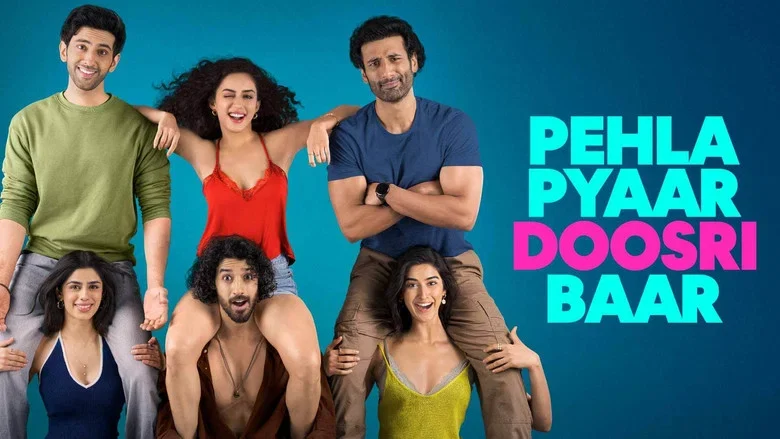
Anuj Saini opens on a Delhi office floor where the fluorescent light does the work of a character: three colleagues staring at spreadsheets while wedding invites pile up on their desks. It is the loneliest image in Pehla Pyaar Doosri Baar, and the film spends the next two hours trying to escape it.
Three Crushes, One Drunken Road Trip, Zero Rehearsal
The premise has a clean, almost mathematical appeal. Gautam, Vedant and Shivi are single office drones watching their peers marry off, so they drink themselves into a decision and drive to a Mussoorie school reunion to resurrect old crushes.
Saini stages this ignition with real comic energy. The trio treats unfinished schoolboy longing like a corporate project with a deadline, and for twenty minutes the film believes in its own absurdity.
Then the reunion arrives and the arithmetic splits three ways: Gautam wants Gehna, Vedant wants Simran, Shivi wants Karan. Three parallel pursuits, three sets of stakes, and a screenplay that never decides which one deserves the camera.
When Commitment Anxiety Replaces Character
Gautam’s track is the film’s clearest demonstration of its central problem. He reconnects with Gehna, a confident woman nursing a recent heartbreak, and the intimacy lands with genuine warmth.
The moment she asks for permanence, he retreats into a commitment panic so familiar it could be photocopied from a decade of Hindi rom-coms. Sparsh Walia plays the shy idealist with a soft, unforced awkwardness, his shoulders fold inward at exactly the right beat, but the writing gives him no second gear.
The screenplay mistakes hesitation for depth. Gehna’s sharpest line, “Hot hona bhi bohot badi problem hai, ” lands like a joke from a better movie trapped in this one.
The Wedding Deadline That Does All the Heavy Lifting
Vedant’s arc has the most conventional architecture and, oddly, the most momentum. Kunal Vaid plays him with a boyish forward lean, and his confession to Simran briefly makes the whole enterprise feel reciprocal.
Then Vikesh arrives, the fiancé, played by Gobind Singh Mehta with the placid confidence of a man who has already won. His presence converts the reunion romance into a countdown, and the film suddenly has a clock.
It is telling that the only engine that reliably generates tension here is a wedding date on a calendar. Sarvagunn Sampann at least had the nerve to interrogate the identity comedy it was selling; this one simply installs the fiancé and hopes urgency will pass for feeling.
A Makeover That Argues Against Its Own Heroine
Shivi’s track is where the film’s instincts curdle. Sargun Kaur Luthra gives her a blunt, unguarded energy, she swears, she slouches, she refuses to be merely “cute.”
Then the screenplay hands her a makeover to win a serial womaniser. When Karan calls her cute and she insists she wants to be sexy, the exchange plays as comedy, but the camera’s sympathy has quietly shifted to the wrong side.
Her eventual realisation that the intimacy was never reciprocal is the film’s most honest emotional beat. It arrives too late to rescue an arc that spent its screentime arguing that appearance is the lever.
Chemistry as a Structural Deficit
Here is the hard verdict on the craft: the pairings do not generate heat. Alisha Chopra’s Gehna has a live-wire frankness that briefly electrifies her scenes, but Walia’s Gautam is too recessive to meet her.
Sakshi Vaidya’s Simran is warm and present, yet the Vedant-Simran bond is asserted more than dramatised. The film keeps telling us these are first loves; it rarely shows us the residue.
Saini’s direction is competent without being distinctive. He shoots the hills in flat, postcard light and the Delhi interiors in the same register, so the nostalgic contrast the story needs never materialises.
Where a sharper filmmaker would have let the reunion setting breathe, the corridors, the old classrooms, the specific embarrassment of seeing who your crush became, Saini cuts to the next plot beat. The music does more emotional work than the staging.
The editing betrays the structure too. The first half moves with purpose through office frustration, drinking, travel and reunion introductions; the second half fragments as three heartbreaks compete for oxygen.
The Ensemble Is the Only Thing Holding the Frame
What genuinely works is the friendship. The three leads share a loose, unforced rapport that reads as people who have known each other too long to perform for one another.
When all three romantic missions collapse into a shared emotional hangover and they redirect themselves toward helping Vedant, the film briefly finds its real subject: adults learning that nostalgia is a poor substitute for nerve.
That pivot is the smartest structural choice in the screenplay, and it is squandered by a climax that races to the wedding without earning the emotional escalation.
Luv Ranjan’s Banner, Anuj Saini’s Hand, and a Market That Rewards Neither
The commercial math here is unforgiving. A Luv Ranjan-associated production carries a specific expectation, bawdy, friendship-led, male-idiom comedy, and this film arrives with newcomers and no established draw.
Opening-day receipts reported at roughly ₹0.22 crore net in India suggest a theatrical footprint closer to a limited release than a mainstream push. For a banner built on franchise-adjacent rom-coms, that is a signal worth reading carefully.
The wider exhibition market has little patience for mid-budget romantic comedies without a star anchor, and this one offers neither spectacle nor a name to sell. Contemporary Hindi comedy is currently split between star-driven farce and streaming-bound character work; this sits awkwardly between the two.
Just as the filmmaker behind Haiku built an intriguing premise and then failed to narrate his own idea, Saini assembles a workable engine and stalls on the transmission.
The comparison to Orijinal is instructive in the opposite direction: that film’s lead anchored a puzzle that threatened to outsmart itself, whereas here the puzzle is simple and the anchoring is thin.
The Uncomfortable Lesson of a Second Chance Nobody Earned
The film’s thesis, whether it intends it or not, is that first love is mostly a story we tell ourselves about a person who has since become someone else. Gehna has changed. Simran has a fiancé. Karan was never worth the makeover.
That is a genuinely adult idea, and the movie keeps flinching from it in favour of wedding-day rescue mechanics. The ending wants to be about honesty and timing; it settles for a deadline met.
Walia and Luthra will work again, there is screen presence here, unpolished but real. What they need is a script that trusts its own melancholy instead of dressing it in borrowed comic business.
Pehla Pyaar Doosri Baar is a film about the gap between who we loved and who we became, made by people who never quite decided which of those two movies they were making. The result is a reunion you attend out of obligation, not longing.

Recommended for You
Detective Teekshanaa (2026): Priyanka Upendra’s Sleuthing Drama Stays Methodical, Never Thrilling
The trailer’s rapid montage of murders promises a detective who pieces together chaos through pure observation. Priyanka Upendra enters the frame as…
Sarvagunn Sampann (2026): Vaani Kapoor’s Identity Comedy Is a Curious Oddity
The teaser’s defining image is unmistakable: Vaani Kapoor split across two looks, one demure and one dangerously close to a public fantasy,…
Cocktail 2 (2026): Adajania’s Ensemble Romance Stumbles on Narrative Clarity
A long-term relationship fractures the moment an old friend materializes, igniting a scheme between two women that spirals into emotional chaos. Homi…