Shankarabharana (2026): Shine S Shetty and a Haunted Bus That Runs on Dignity

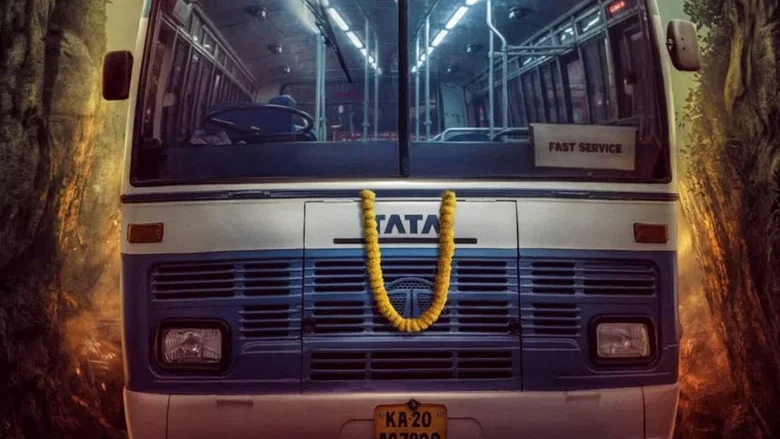
Shankara names his bus before he names his fear. The vehicle arrives mid-film, bought with family gold, and Sumanth Bhat spends the next hour turning that steel chassis into a coffin with a route number.
A Working-Class Hero Buys His Own Noose With Borrowed Gold
The first act belongs to humiliation. Shankara drives for Madhukar, a transport magnate whose son treats the hired wheel like furniture, and the film lets that disrespect sit in the frame without cutting away.
What Bhat understands is that ownership is the only dignity available to men like Shankara. The gold pledge scene lands hard because it is not a celebration; it is three generations converting their safety net into a vehicle they cannot afford to lose.
Contrast this with the economic desperation in Pratap, where power is stripped away by force rather than debt. Bhat’s protagonist loses his leverage voluntarily, which is a crueller dramatic choice.
Thoudgudi Is a Route, Not a Setting, and That Is the Film’s Smartest Gambit
The genre pivot happens the moment dispatch assigns Shankara the abandoned Thoudgudi stretch. The bus does not stop at the haunted village; it must pass through it, return through it, and earn through it.
That structural decision keeps the supernatural threat economically loaded. Every ghost sighting costs him a fare, and every fare is a repayment on gold he cannot reclaim.
The coastal Karnataka folklore here is not decorative. Bhat uses local rumor, PT Sudha, the buried history, the unsettling presence, as a social ledger, and the horror becomes the village collecting on debts the living never acknowledged.
Sampath Raj’s Stillness Does More Damage Than Any Jump Scare
Sampath Raj plays Sudhakara with a voice kept below conversational register, and his menace comes from how little he moves. He occupies doorways and lets Shankara walk past him, and the framing never lets the audience forget who owns the room.
Shine S Shetty, meanwhile, plays exhaustion as posture. His shoulders round when he climbs into the driver’s seat, and the way he grips the wheel in the Thoudgudi sequences suggests a man holding on to his own name rather than a steering column.
The supporting cast is thinner than the film needs. Tanvi Ram’s Jenny and Krithi B Shetty’s Shanti exist to support the purchase and then fade, and the screenplay never gives them a scene that exists outside Shankara’s ambition.
The comic register the film attempts, the adventure-comedy classification is not accidental, mostly misfires, because the humor arrives in the same breath as dread and neither register wins the room.
Bhat Trusts Silence, Then Loses His Nerve in the Final Stretch
The director’s best passages are almost wordless: the bus idling at the edge of Thoudgudi, headlights cutting a road that has no business existing, the sound design dropping to engine hum and wind.
Where the film wobbles is in the back half’s escalation. The scares grow louder and the score grows busier, and the quiet authority of the first hour gives way to conventional supernatural staging.
The tonal whiplash is instructive. The Kannada thriller space has been drifting toward grim procedural realism lately, and the strain shows in Lambodhara 2.0, where the algorithm of the genre outpaces the heartbeat. Bhat’s film has the opposite problem: a heartbeat in search of a steadier pulse.
Compare the tonal control of Party Animals, which at least commits to its register. Shankarabharanna keeps hedging between folk horror and crowd-pleaser and ends up serving neither appetite fully.
The Box Office Question Is Whether Kannada Horror Can Carry a Working-Class Drama
The producing banners behind this release are betting on a hybrid audience that rarely shows up twice. Regional horror travels well when it is loud; it travels poorly when it asks viewers to sit with debt and humiliation for an hour first.
Shine S Shetty’s theatrical leverage is real but narrow. He can open a film in Karnataka, and he can hold a screen, but he cannot yet carry a national release on name recognition alone.
The remake pipeline that has sustained the southern exhibition circuit for a decade is running dry, and originals like this one are the test case. If the film holds past week two, the argument for original Kannada horror strengthens considerably across contemporary Kannada thrillers.
The Bus Was Never the Point, and That Is the Film’s Quiet Cruelty
By the final act, Shankara has learned what the audience suspected from the first frame: dignity purchased on credit is still debt, and the village of Thoudgudi has been collecting interest for generations.
The ending does not resolve so much as settle. The bus survives, or does not, and either way the gold is gone and the road remains.
Bhat has made a film about the price of self-respect that refuses to let its hero enjoy the purchase. It is a haunted-house story where the house is a bus, the ghost is a hierarchy, and the driver is the only one who cannot get off.
Explore Cinema Hubs

Recommended for You
Pati Patni Aur Woh Do (2026): Ayushmann’s Panic Carries a Premise Running on Fumes
Prajapati Pandey stands in a Banaras alley, caught between his wife’s phone calls and a friend’s crisis, each trip to the city…

Michael (2026): Fuqua’s Biographical Ambition Undercut by Uneven Craft
Jaafar Jackson steps into his uncle’s shoes as the film traces the rise of a child performer into a solo phenomenon, beginning…
Governor (2026): Manoj Bajpayee Anchors Nation’s Economic Reckoning
India teeters on bankruptcy’s edge as fuel shortages spread panic and inflation devours the economy whole. A reluctant bureaucrat named A. Ramanan…