Pati Patni Aur Woh Do (2026): Ayushmann’s Panic Carries a Premise Running on Fumes


Prajapati Pandey stands in a Banaras alley, caught between his wife’s phone calls and a friend’s crisis, each trip to the city another secret he cannot explain. The misunderstanding that follows, Aparna’s slow certainty that her husband is entangled in an affair, spreads like ink through water, pulling in Nilofer, widening into domestic suspicion that the film mistakes for escalation.
Mudassar Aziz’s romantic comedy rests entirely on one mechanism: concealment breeding panic. It works once. Repeat it across an hour, and the machine begins to grind audibly.
Ayushmann Khurrana’s Reactive Comedy Carries the Weight Until the Structure Collapses
Ayushmann anchors the film through sheer performative stamina, channeling a man whose good intentions become his greatest liability. His Prajapati is reactive, constantly managing Aparna’s suspicion, managing Chanchal’s problem, managing the escalating fiction he has built, and Khurrana’s strength lies in playing the exhaustion of that juggling act without ever breaking character. The role demands he shift between domestic normalcy and concealment-driven panic, and those tonal pivots are where his craft shows itself most clearly.
Yet by the midpoint, even his energy cannot sustain the repetitive structure. Once the suspicion logic locks in place, the screenplay recycles the same beats, and Ayushmann becomes trapped in a loop of his own film’s design.
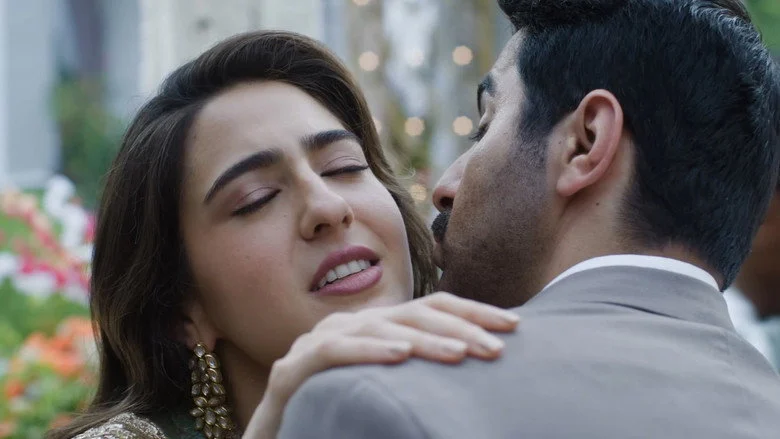
Mudassar Aziz Sustains the Setup; the Screenplay Outstays Its Welcome
The director maintains narrative clarity throughout, the misunderstanding engine remains legible, the timeline stays coherent, but this is also the film’s weakness. Clarity alone is not enough when the same conflict repeats. Aziz leans on structure rather than variation, letting the middle section expand the suspicion to Nilofer without deepening the emotional stakes.
The screenplay, co-written by Ravi Kumar and Aziz, constructs a workable premise but depends too heavily on prolonged secrecy. The affair misunderstanding becomes the film’s only conflict device, deployed until it frays.
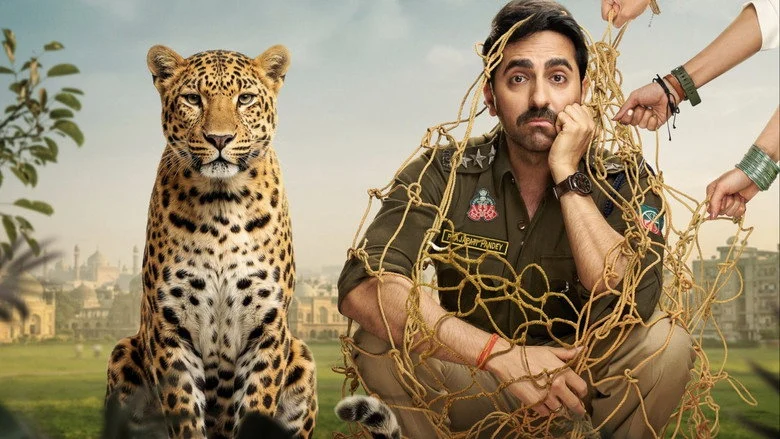
The Misunderstanding Chain Peaks Early, Then Becomes Mechanically Extended
The romantic-comedy framework here lives or dies by how long the central confusion can sustain audience investment. The first act establishes Prajapati’s marriage to Aparna as stable, then Chanchal’s arrival introduces the Banaras thread, a personal crisis involving her boyfriend Sunny and his politically connected father, Gajraj Tiwari, who opposes the relationship on caste grounds. The setup is clean and familiar enough to be immediately legible.
The comic chaos peaks when Prajapati’s repeated trips to Banaras remain unexplained to Aparna, triggering her suspicion of an affair. That sequence, the gradual accumulation of small lies, the phone calls Aparna cannot quite explain, the slow dawning certainty, carries genuine comedic potential. The misdirection lands because it plays against what the audience knows.
Then the film retreats into the same suspicion beats. Nilofer becomes entangled in the affair misunderstanding, widening the confusion without deepening it. The second half does not escalate; it repeats. The final reveal, the truth about why Prajapati helped Chanchal, the confrontation of marital tension after deception is exposed, arrives after the comedic engine has already run dry.
Audiences familiar with Hindi comedy may find this framework comfortable, though comfort here borders on mechanical repetition. The earlier Pati Patni Aur Woh used cleaner comic premises; this sequel-in-spirit stretches the same logic beyond its natural shape.
For those seeking deeper Hindi film analysis, Hindi Comedy reviews across our archive offer context on how this formula has evolved.
Wamiqa Gabbi, Sara Ali Khan, and Rakul Preet Singh Inhabit Roles Larger Than Their Scenes Allow
Wamiqa Gabbi’s Aparna carries the emotional weight of the suspicion arc, she is the marital viewpoint, the wife whose doubt feels entirely rational given what she observes. Gabbi grounds Aparna’s suspicion in genuine hurt rather than mere comic fuel, which means the character often feels stranded when the film prioritizes jokes over her internal state. Her performance suggests a richer domestic drama underlying the comedy; the script does not always honor that suggestion.
Sara Ali Khan’s Chanchal functions as the catalyst who sets the entire misunderstanding in motion. Her performance anchors the Banaras thread and provides the emotional justification for Prajapati’s secrecy, yet she spends much of the runtime offscreen while her problem drives the main plot. Rakul Preet Singh’s Nilofer, drawn into the suspicion web, becomes another vehicle for expanding the confusion rather than a character with her own dramatic arc. Tigmanshu Dhulia’s Gajraj Tiwari represents the social-status obstacle, oppositional force rather than a fully realized antagonist, but his presence signals that the film is aware of the caste dimension underlying Chanchal’s crisis.
A Premise Built on Secrecy Cannot Hide Its Own Structural Limits
The central tension of Pati Patni Aur Woh Do rests on a question that romantic comedies have wrestled with for decades: how long can misunderstanding sustain narrative engagement before it becomes implausible that the truth remains hidden? The film’s answer appears to be: not quite this long. The reliance on prolonged concealment and miscommunication, while thematically coherent, makes the middle section feel less like organic escalation and more like deliberate mechanical extension.
The film does not stumble on subtext or ambition, it simply overstays the welcome of its own joke. The Banaras setting and the Canada escape plan provide peripheral stakes, but they remain secondary to the core misunderstanding logic. Once that logic exhausts itself, there is little else sustaining the narrative forward.
If you value ensemble chemistry and situational comedy over narrative momentum, the casting of Ayushmann, Wamiqa, Sara Ali Khan, and Rakul Preet Singh creates enough interpersonal texture to carry you through. If you need variation in your conflict structure, the middle hour will feel like watching the same scene refracted through different characters.
The film works best as a streaming watch where you can pause through the repetitive stretches; its romantic-comedy pleasures are real but finite. I found myself admiring Ayushmann’s stamina more than the structure supporting it, which feels like the film’s central problem in miniature.
Pati Patni Aur Woh Do is a functional romantic comedy buoyed by strong casting but ultimately undermined by structural repetition that no amount of ensemble charm can fully overcome, a solid 2.5 out of 5.
Ayushmann’s commitment to the panic-driven comedy recalls Mandalorian Grogu review‘s willingness to sustain emotional weight through familiar beats.
The film’s struggle to evolve beyond its central premise mirrors Michael verdict‘s tension between ambitious scope and execution.

Recommended for You
Qaid (2026): Dhruv Jain s lands hard though the screenplay stays patchy
There is a moment in Qaid where Dhruv Jain simply sits still, and the camera refuses to blink. The film trusts that…
Ikka (2026): Sunny Deol Anchors stands out while the narrative loses grip
The courtroom goes silent as Sunny Deol’s Arjun Mehra, the man who never loses a case, locks eyes with Akshaye Khanna’s Shauryaman…

The India Story (2026): Shreyas Talpade the lifts key stretches, not the full runtime
Talpade plays a man wrestling with a system that has failed him. His face carries the exhaustion of someone who has seen…