Little Thomas (2026): Hridansh Parekh Anchors a Gentle, Single-Track Goa Memory

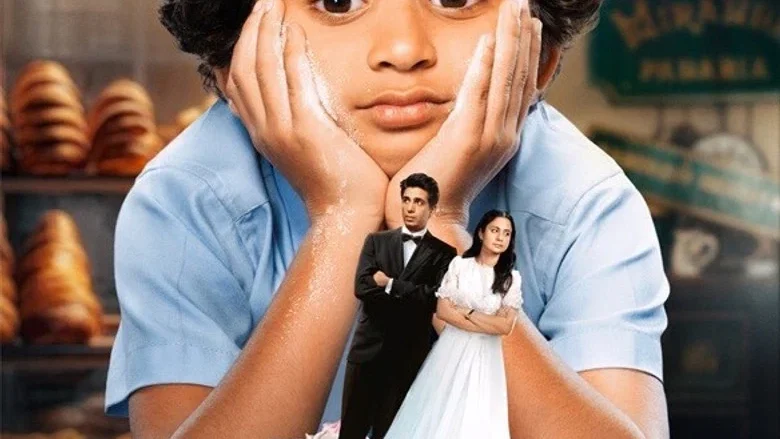
Kaushal Oza opens on a seven-year-old’s face in Fontainhas, and the film’s whole gamble is written there: a child solving adult sadness with child logic.
Thomas wants a brother. He believes a kiss is the machinery that produces one. Everything else follows.
A Child’s Arithmetic Applied to a Marriage That Is Quietly Sinking
The premise is elegantly small. Thomas Miranda watches neighbours with siblings and concludes his household is incomplete, not unhappy.
His parents Jessie and Desmond run a piano-teaching practice and a bakery respectively, and the film renders their exhaustion through ledgers, closing costs, and the particular silence of two people who share a bed and a budget but not a conversation.
What makes the conceit land is its refusal to explain itself. Thomas treats conception as a procedural task with a clear input and a desirable output, and the comedy sits in the gap between his certainty and our knowledge.
That same discipline recalls the spatial economy Oza brought to the cricket-nostalgia experiment of Doosra, where restraint did the heavy lifting that dialogue could not.
When the Mission Never Escalates, Momentum Becomes the Casualty
Here is where the film’s thinness announces itself. Thomas’s plan is fixed within the first half hour, and the middle stretch keeps returning him to the same tactic without raising the stakes.
The screenplay moves on one track, and after a point the repetition stops generating comedy and starts generating patience.
Adult conflict stays deliberately underdeveloped because we only see it through Thomas’s comprehension, which is thematically coherent but dramatically limiting; Jessie and Desmond never get a scene that exists outside their son’s field of vision.
The consequence is a second half that coasts on charm where it needed one genuine reversal.
Rasika Dugal’s Exhaustion and Gulshan Devaiah’s Kitchen Silence Carry the Adult Weight
Dugal plays Jessie with a tight jaw and a teacher’s practiced patience that keeps slipping into fatigue. Watch her hands at the piano: they keep working long after her attention has left the room.
Devaiah’s Desmond is flour-dusted and physically withdrawn, a man who answers questions with nods and keeps his back turned a beat too long. The marriage reads as worn rather than broken, which is harder to play.
The restraint both actors bring to domestic friction has a comparable weight to the buried tension Yashpal Sharma carried in Dhood (Sandstorm), though here it is spent on grocery bills instead of a knife.
And Hridansh Parekh, in the title role, never plays cute. His Thomas is earnest to the point of solemnity, delivering his theory about kissing with the gravity of a boy presenting homework, and the performance holds the film’s centre without begging for affection.
Fontainhas in the Early Nineties, Rendered in Slow Light
The period setting is the film’s smartest structural decision, not a decorative one. In a pre-search-engine Goa, a seven-year-old has no choice but to build his own theory of where babies come from, and that ignorance is the engine of the plot.
The camera favours doorways, verandah edges, and the low angle of a child watching adults from a corridor, which keeps us permanently inside his scale of the world.
Where the film betrays its own tension is in the edit. Scenes are allowed to sit past their dramatic usefulness, and the cumulative effect is a gentleness that curdles into inertia.
It is a tonal gamble that a sharper family study like Second Marriage Season 1 also wrestled with, and the comparison is instructive: both films trust atmosphere over escalation, and both pay for it in the middle act.
Four Banners, One Small Film, and a Box Office That Never Showed Up
The producing coalition here, Luminoso Pictures, Civic Studios, Good Bad Films, and Flip Films, is a patchwork of smaller banners pooling resources around a modest, director-driven project, which tells you exactly how this film was financed and exactly how much room it had to fail.
It failed quickly. Opening visibility was thin, publicity was thinner, and the theatrical run never built the word-of-mouth that a gentle family film needs to survive past week one.
For Devaiah and Dugal, both reliably excellent and both commercially marginal as solo draws, this is the recurring arithmetic of the mid-budget Hindi drama: critical goodwill does not convert into footfalls without a marketing engine behind it.
The broader exhibition ecology for intimate, character-led Hindi storytelling remains brutal, as the current landscape of contemporary hindi familys on screen keeps demonstrating, and this release is another data point rather than an exception.
A Boy Learns That Love Cannot Be Scheduled Like a Piano Lesson
The ending refuses the easy repair. Thomas does not get his brother, and the film does not pretend his plan worked; what shifts is his understanding that his parents’ distance was never a problem he was assigned to solve.
That is a more honest resolution than the premise promises, and it lands because Parekh plays the recognition without tears, just a boy quietly putting away a theory he has outgrown.
Little Thomas is a film of real tenderness and one structural blind spot, and it will find its audience on a smaller screen where its patience is a virtue rather than a liability.
It asks us to remember what it felt like to believe we could fix the people we love by simply wanting it hard enough, and then gently informs us, as adulthood did, that we could not.

Recommended for You
Soulmates – Oru Saathukkudi Pranayam (2026): Nivin Pauly Anchors Meta-Romance That Plays Too Safe
Joel Davis walks into the frame of a film that is not quite his own, pitching a short film about a mosambi,…
I, Nobody (2026): Prithviraj’s Controlled Thriller Loses Its Grip in the Final Reel
Rajeevan is just another government employee when he witnesses something he shouldn’t have. The bank robbery aftermath that follows turns his routine…
Anbe Diana (2026): A Sweet Romance Held Up by Pari Elavazhagan’s Charm
There is a particular kind of Tamil romance that believes love can bulldoze every social barrier, and Pari Elavazhagan’s directorial debut leans…