Dhood (Sandstorm) (2026): Yashpal Sharma Anchors A Rajasthani Chamber Thriller That Buries Its Knife Too Deep

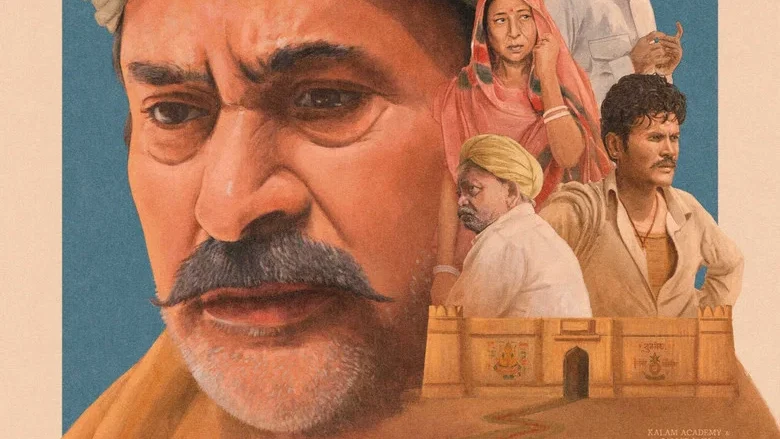
The Thar Desert does not need a score to feel hostile. Anand Singh Chouhan knows this, and for long stretches of Dhood, he simply lets the sand and the silence do the threatening.
What the film does with that silence, and what it refuses to do, is the whole argument.
A Rajasthani Thriller That Refuses To Announce Its Own Villain
The premise is lean and mean: an isolated family in the early 1990s, a lineage under threat, and a household that slowly turns into a pressure cooker with no release valve.
Chouhan stages the opening not as a mystery but as a ritual, the family performing its own preservation, reciting its own importance, oblivious to the rot inside the walls.
The film’s smartest instinct is structural. It distributes the antagonism across the family unit itself rather than importing a convenient outsider, which is precisely the kind of contained, character-driven tension that has been quietly gaining traction across contemporary Hindi thrillers.
There is no mustache-twirling figure to boo. There is only inheritance, greed, and the quiet violence of people who believe they are owed something.
When The Countdown Outpaces The Characters
Here is where Dhood starts to strain. The “dark domestic countdown” framing promises escalation, but the screenplay treats escalation as a matter of volume rather than revelation.
Conversations get louder. Accusations get sharper. But the audience is rarely given the gift of a genuinely new piece of information, a secret that recontextualizes what came before.
Compare this to the lean efficiency of Naa Wife Missing, which understood that a thriller’s engine runs on withheld facts, not raised voices.
Dhood withholds plenty. It just doesn’t always know which facts are worth withholding.
Yashpal Sharma Holds The Center With Stillness, Not Volume
Yashpal Sharma has spent three decades playing men who carry authority like a physical weight, and here he pares that down to something almost geological.
Watch his hands in the family confrontation scenes. They stay folded. His voice drops when everyone else’s rises. It’s a performance built on the assumption that the most dangerous man in the room never needs to prove it.
The contrast with his broader, more theatrical register, the kind of work that made him memorable in Pehla Pyaar Doosri Baar, is instructive. Here, restraint is the whole performance.
Alka Amin matches him beat for beat in the domestic sequences, her silences carrying more accusation than any line of dialogue the script hands her.
The debuting ensemble around them is more uneven, visibly reaching for intensity in scenes that would benefit from half the effort.
Sand, Shadow, And A Score That Knows When To Shut Up
The visual grammar is disciplined to a fault. Chouhan and his team favor wide, static compositions that trap the family inside the frame, the desert horizon pressing in from every edge.
Interiors are lit with a single warm source, so faces fall into shadow at exactly the moments the characters are lying to each other.
Mehul Surti’s score is used sparingly, sometimes too sparingly, leaving stretches where the film feels emotionally undernourished rather than deliberately austere.
This is the same instinct that made Gajab Raat feel confident in its own skin: trust the frame, trust the actor, trust the audience. Dhood trusts all three. It just doesn’t always earn that trust back.
A Regional Gamble With Real Stakes For Soul Of Desert
Soul of Desert Production, in collaboration with Ainak Co-Labs and presented by Kalam Academy, is making a bet that a Rajasthani-language psychological thriller can travel beyond its linguistic borders.
That bet is not trivial. Regional cinema that refuses to soften its dialect or its cultural specificity for a pan-India audience is operating on a thin margin, and the producers know it.
The film’s commercial fate will hinge less on Yashpal Sharma’s marquee value, which is real but niche, and more on whether word-of-mouth can convince non-Rajasthani viewers that the desert household is worth two hours of their attention.
If it works, it opens a door. If it doesn’t, it becomes another cautionary tale about ambition outpacing distribution.
The Ending Doesn’t Resolve So Much As Refuse
Without spoiling the final act, it’s fair to say Dhood ends on a note of unresolved weight rather than catharsis. The family’s legacy is preserved, but at a cost the film refuses to sentimentalize.
That refusal is admirable in theory. In practice, it leaves the audience with a question the screenplay never quite earns the right to ask.
Dhood is a film of real discipline and real restraint, anchored by a lead performance that understands exactly how much to give away. It is also a film that mistakes silence for depth more often than it should.
See it for Yashpal Sharma’s folded hands and Alka Amin’s loaded pauses. Just don’t expect the sandstorm to fully arrive.

Recommended for You
Kalpana Aur Yatharth: Salil Singh’s Reality-Bending Drama Is A Ghost Of A Film
The most telling detail about Kalpana Aur Yatharth is that its own director plays the man doing the searching. Salil Singh casts…
Beyond Ratings (2026): A 2.3 IMDb Score That Speaks for Itself
Some films arrive with hype, others with hope. Beyond Ratings arrives with an IMDb score of 2.3 from 895 votes, a number…
Crazy Kalyanam (2026): Anupama Parameswaran Anchors A Sincere But Uneven Rural Drama
Anupama Parameswaran plays Keerthi, a young woman in rural Telangana who wants to finish her education before anyone finishes arranging her life.…