Manduka (2026): Bhushan’s Fractured Crime Puzzle Never Finds Its Center

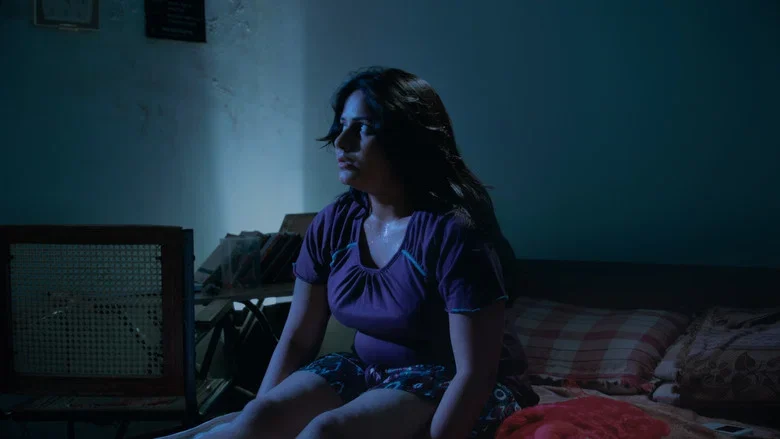
Bhushan opens Manduka on a girl mid-collapse, her perception splintering just as four criminals stumble into her orbit. What follows is a hundred and four minutes of pursuit that keeps promising a mystery and keeps withholding the mind to solve it.
A Schizophrenic Protagonist Deserves More Than A Plot Device
The inciting incident is genuinely unnerving: a vulnerable young woman collides with a criminal quartet, and the police close in from the perimeter. On paper, that triangulation of illness, concealment, and pursuit should generate unbearable pressure.
Instead, Bhushan treats the schizophrenia as a fog machine. It obscures plot mechanics rather than illuminating a consciousness, which means the audience spends the middle stretch guessing at the rules of a game nobody has explained.
Compare the discipline on display in KillR, where fragmented perspective is anchored to a coherent emotional throughline. Here the fragmentation is the whole architecture, and it buckles.
Four Villains, Four Silhouettes, Zero Antagonists
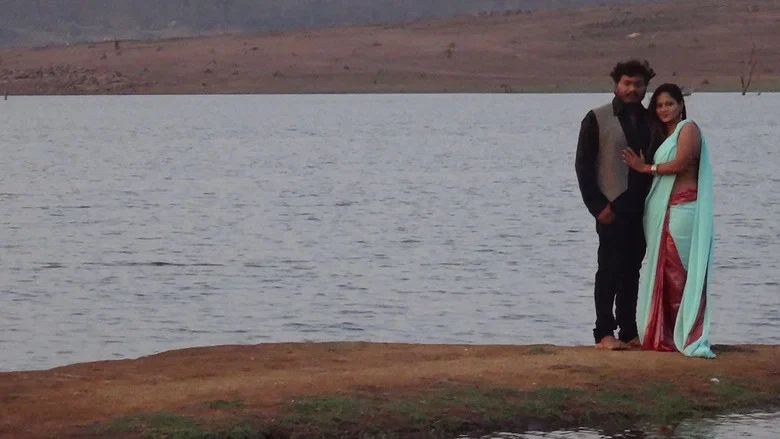
The criminal group is the film’s structural bet, and it never pays off. Mysore Raju and Zoom Ravi register as physical presences, all jaw and shoulder and menace, but the screenplay gives none of the four a distinct motive or method.
Bhushan himself takes a negative role while also directing and writing, which should produce unified intent. What it actually produces is a filmmaker spread so thin that his own villainy feels like an obligation rather than a threat.
The police pursuit, meanwhile, runs on fumes. Manjunath Mirle’s officer moves through corridors and doorways with procedural purpose, but the cat-and-mouse framework never tightens into genuine geometry.
Anjala Holds The Frame While The Script Slips Away
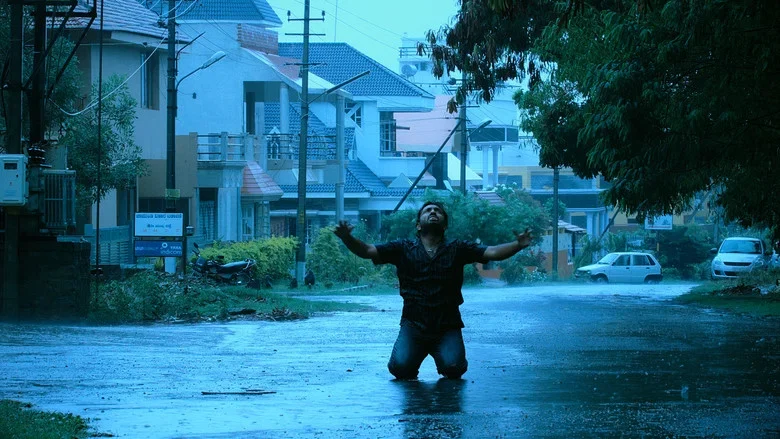
Anjala is the reason to keep watching. She plays the girl’s destabilized attention with a specific physical vocabulary: a delayed blink, a head tilt that arrives half a second late, hands that grip a doorframe as if testing whether it is real.
Those micro-choices carry more narrative information than the dialogue does. The performance recalls the quiet devastation of Pyre, where stillness does the work that exposition cannot.
But the screenplay keeps interrupting her. Every time Anjala builds a moment of interiority, Bhushan cuts away to a criminal conferring with another criminal about nothing the audience can track.
Bhushan’s Camera Knows Where To Stand And Not Why
The visual scheme is functional in the narrowest sense. Bhushan favors medium shots that keep the girl isolated in the frame’s negative space, and the lighting in the criminal hideout is deliberately sour and green.
What the film lacks is rhythm. Scenes hold past their dramatic usefulness, then snap forward without transition, and the score pushes tension into moments that have not earned it.
The compact runtime should be an asset. Instead it exposes how little of the middle act has been built, and the climax arrives before the film has established what is actually at stake.
The Kannada Thriller Wave Needs Sharper Tools Than This
The film arrives in a market hungry for exactly this kind of stripped-down regional crime picture. The comparison to Bail is instructive: that film overstuffs, but it commits to a point of view about policing and class that Manduka never locates.
Bhushan’s production appears to be a modestly scaled independent effort, and the ₹75 lakh budget bracket explains the limited locations and the absence of spectacle. The commercial math is unforgiving at that scale.
What the film needs is not more money but a second draft. The premise is strong enough to sustain a lean, mean thriller, and the lead performance is strong enough to carry one.
A Closing Image That Almost Redeems The Confusion
The final stretch finally locates the film’s real subject: the terror of not being believed. Anjala’s face in the last minutes, caught between certainty and collapse, is the only moment where the film’s competing perceptions fuse into something coherent.
It is a genuine achievement, and it arrives too late to retroactively organize the seventy minutes that preceded it.
Manduka is a calling card for its lead actress and a cautionary tale for its multi-hyphenate director. The Kannada crime thriller is thriving right now, and this one is not yet sharp enough to join the conversation.
Explore Cinema Hubs

Recommended for You

Ranabaali (2026): Vijay Deverakonda’s Famine-Era Revolt Sings, Then Sags
Somewhere in the third hour of Ranabaali, a British commissioner asks a starving village what it wants, and the answer arrives not…
Subedaar (2026): Anil Kapoor’s Veteran Drama Has Quiet, Stubborn Conviction
A retired Subedaar named Arjun Maurya builds a quiet civilian life, until a reckless act tears it open, forcing a man who…

G.D.N (2026): Madhavan Holds the lands hard though the screenplay stays patchy
There is a moment early on when R. Madhavan, as the self-taught inventor G.D. Naidu, demonstrates a piece of his own engineering…