Ranabaali (2026): Vijay Deverakonda’s Famine-Era Revolt Sings, Then Sags


Somewhere in the third hour of Ranabaali, a British commissioner asks a starving village what it wants, and the answer arrives not as dialogue but as a horse at full gallop. That image, hunger answered by motion, is the film Rahul Sankrityan has built, and for two acts it is enough.
A Horseman Rides Into A Famine, And The Film Finds Its Engine
Vijay Deverakonda plays Singanamala Bobbili Ranabaali, a protector of a Rayalaseema village during the Madras Famine of 1876–78. The film opens not on battle but on scarcity: cracked earth, rationed grain, British officers quantifying human suffering in ledgers.
It is a canny choice. Where a lesser period action would open on a sword, Sankrityan opens on a scale. The colonial machine is introduced as bureaucracy first, violence second, and that sequencing gives the eventual revolt a moral ledger rather than a mere body count.
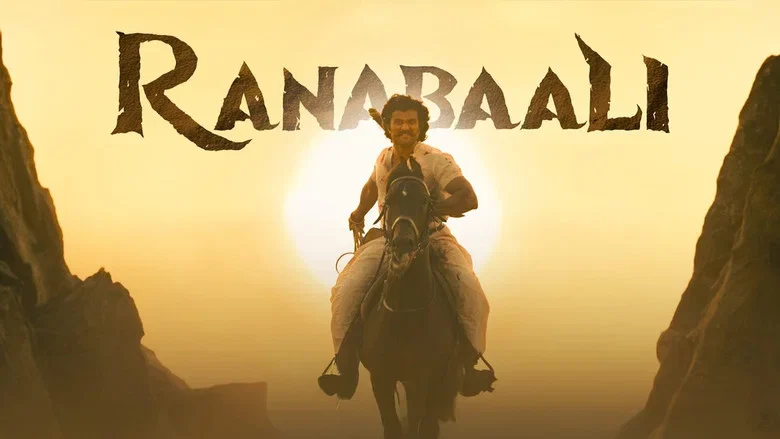
Deverakonda’s entrance is staged as folklore in motion, a rider cutting across open land, the camera holding long enough to let his physical ease with the animal do the acting. It is the film’s cleanest piece of characterization: this man is defined by mobility in a world that is closing in.
Arnold Vosloo’s Commissioner Is The Right Kind Of Still
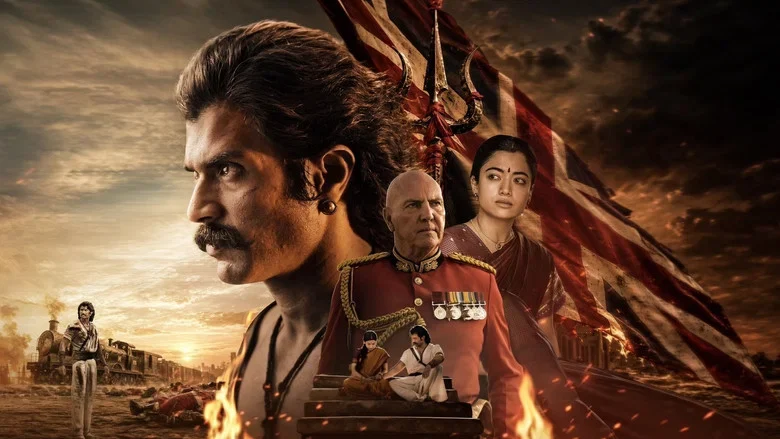
Arnold Vosloo, as Sir Theodore Hector, is the film’s most disciplined piece of casting. He plays the commissioner with a low, unhurried voice and a habit of folding his hands before delivering an order, as though administration were a form of prayer.
He never raises his voice. That restraint is the point. The film understands that famine is not a shouting crime, and Vosloo’s stillness, the way he studies a starving child the way he might study a column of figures, gives the antagonist his menace without a single raised eyebrow.
The trouble is that the screenplay does not give him enough scenes opposite Deverakonda. The two share perhaps four real confrontations, and each one is good enough that you feel the vacuum around them.
Rashmika Mandanna Is Given Presence Without A Function
Rashmika Mandanna’s Jayamma is a principal character by billing and a bystander by construction. She is given moments of defiance, a refusal, a look held across a courtyard, but the film never assigns her an action that changes the plot’s direction.
The gap is stark when set against her work in Cocktail 2, where the ensemble at least gave her competing voices to react against. Here she is a moral anchor with nothing to anchor, and the performance, however committed, has nowhere to land.
There is a scene where she watches Ranabaali ride out and the camera holds on her face for a beat too long, the film reaching for interiority it has not earned. It is a directorial instinct in search of a written role.
The Middle Act Repeats Its Own Argument
Once Ranabaali moves from village defender to armed resistance leader, the film settles into a rhythm of raid, reprisal, and speech. Each sequence is competently staged; several are genuinely tense, particularly a night ambush staged almost entirely in silhouette.
But the escalation is horizontal rather than vertical. The stakes widen without deepening. By the fourth major confrontation, you can predict the emotional temperature of a scene before the first line is spoken, and that predictability is the film’s real antagonist.
The structural problem is that the historical backdrop is doing more work than the character writing. The Madras Famine is a genuinely underexplored subject in Indian cinema, and the film treats it with appropriate gravity, but gravity is not the same as drama.
The Action Is Physical, The Editing Is Impatient
Sankrityan shoots horse-mounted combat with a preference for long lens and real geography, which pays off. You can feel the weight of a rider turning, the drag of a tired animal, the dust that a chase kicks up. It is tactile in a way that contemporary Telugu action often is not.
Where the film loses its nerve is in the cut. The editing chops the best sequences into fragments, sacrificing spatial clarity for rhythm, particularly in a climactic confrontation that should have been the film’s signature set piece. The staging is there; the patience is not.
Much of the same problem afflicts KJQ, another recent Telugu action film that mistook velocity for tension. Ranabaali is the better film, but the two share a nervousness about letting a moment simply exist on screen.
A Three-Hour Cut That Feels Like A Four-Hour One
The film runs just over three hours, and the length is not the issue, the distribution of it is. The first act is patient and well-observed; the final act is rushed, resolving a colonial conflict in a manner that feels contractual rather than earned.
The climax stages Ranabaali’s confrontation with British power as a personal duel, which is dramatically tidy but thematically reductive. A film about a famine does not get to reduce its antagonist to a single man and then dispatch him.
What the ending needed was the collective, the village, the starving, the ordinary people whose survival was the film’s stated stake. Instead, the camera retreats to one hero on one horse, and the film’s political ambition quietly collapses into star-vehicle convention.
What Mythri Movie Makers Is Actually Betting On
Mythri Movie Makers has staked a substantial period production on Deverakonda’s ability to carry a scale that his recent filmography has not tested. The film is a clear attempt to reposition him from urban romantic lead to historical action hero, and the campaign has been built accordingly.
The commercial risk is real. Period action in Telugu cinema has been inconsistent at the box office, and Ranabaali’s runtime, grim subject matter, and lack of a contemporary hook narrow its reach. The dubbed Hindi, Tamil, Kannada and Malayalam versions are an attempt to widen the funnel, but the film’s regional specificity is also its strongest asset.
What the film does have is a genuinely underserved historical subject and a lead actor who looks physically at home in the period. Whether that is enough to sustain a franchise, and the ending clearly leaves room for one, will depend on whether audiences reward ambition over execution.
The film’s relationship to its own genre is instructive. Where Toxic energized its opening before losing momentum in the payoff, Ranabaali does the opposite: it builds slowly and then squanders its final act on a confrontation the film has not earned.
A Film That Knows Its History Better Than Its People
Ranabaali is at its best when it is quiet, a commissioner’s folded hands, a rider’s long approach, a village measuring out its last grain. It is at its weakest when it remembers it is a mass action film and reaches for the familiar beats.
That tension runs through the whole enterprise. Sankrityan has made a film that is more interested in the conditions of famine than in the mechanics of revenge, but the industry has trained him to deliver the latter, and the compromise shows in every act break.
The result is a film worth seeing for its ambition and its central performance, but one that will frustrate anyone hoping the period setting might produce something formally braver. The scale is contemporary Telugu action at its most expensive; the storytelling is still playing it safe.
There is a moment late in the film when Ranabaali looks out over land he cannot save, and for a few seconds, the film becomes what it could have been. Then the score swells, the horse rears, and the movie remembers what it is supposed to be.

Recommended for You
Dulhaniya Le Aaeegi (2026): Khushalii Kumar Anchors lifts key stretches, not the full runtime
The wedding mandap is set, the families are squabbling, and Navya, a 32-year-old heiress played by Khushalii Kumar, is told she must…
Happy Raj (2026): G.V. Prakash’s Comedy Charm Runs Thin Fast
A musician-turned-actor steps into a world of romantic chaos and comic misadventure, that is the universe Happy Raj promises to inhabit. Director…
Ottam Thullal (2026): A Rural Family Entertainer Banking on Ensemble Comfort
There is a certain comfort in the familiar rhythm of a Malayalam rural family entertainer, the kind that promises a village square,…