Geriga (2026): Rishan Sha and a Ritual Built on Sand

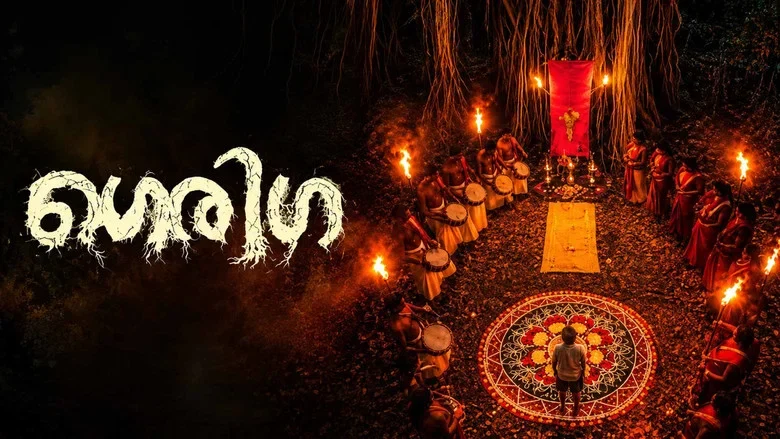
Bhaskar Bantupalli’s possession thriller opens on a Kerala village that still believes its dead can be called home, then hands the ritual to five YouTubers with a ring light. The premise is genuinely dangerous. The execution keeps forgetting it.
A Sacred Rite Reduced to Content, and the Bill That Never Comes Due
Naivad is drawn with a specificity that most regional horror skips: a village where the Geriga rite is treated as obligation, not folklore, and where the elders watch outsiders the way one watches a lit match near dry grass.
Vijay and his crew arrive to stage the summoning as a hoax. The film’s best idea is that this desecration is not punished by an abstract curse but by the ritual functioning exactly as advertised.
Rishan Sha plays Vijay with an easy, camera-hungry grin in the early reels, thumb hovering over the record button, and the screenplay uses that vanity as the fuse. When the possession lands, it lands at the same moment news arrives that his father has died.
That collision of supernatural seizure and sudden bereavement is the film’s strongest dramatic junction, and the only stretch where Bantupalli’s staging feels genuinely unsettled. What follows is a twelve-day countdown to complete the rite properly, and the clock becomes both the engine and the crutch.
The Countdown That Manufactures Urgency Instead of Dread
A deadline is not atmosphere. Once the group is told they have twelve days, the middle act settles into a repetition of research, argument, and failed procedure that keeps restating the stakes rather than deepening them.
The film never establishes the rules of its own mythology with any rigor. What does the entity want, what does completion actually require, and why twelve days and not nine or thirty? The screenplay treats these as given, and dread evaporates when the audience cannot measure the cost of failure.
Where the film reaches for something sharper is in its refusal to let the friends off the moral hook. They filmed a sacred rite for engagement metrics, and the possession becomes a public record of their arrogance. That idea deserves a crueler film than the one that surrounds it.
The village-versus-creator friction recalls the tonal tightrope walked in Maharaja Hostel, which at least knew that a horror-comedy lives or dies on the precision of its tonal shifts. Geriga has no such instinct; it lurches between dread and levity without ever deciding which register owns the frame.
Rishan Sha’s Body Does the Work the Script Won’t
Sha’s post-possession physicality is the film’s most disciplined element. He plays the entity as a subtraction rather than an addition: the grin drops, the spine straightens, and his gaze fixes on a point slightly past whoever is speaking to him.
In the quieter passages, his Vijay sits motionless while the crew argues around him, and Sha lets a single tremor in the jaw suggest something pressing outward from behind the face. It is controlled, unshowy work.
The performance foil is instructive. In Manduka, the ensemble carried a fractured puzzle through sheer presence; here, Sha is left holding a mythology the screenplay never fully assembles around him.
The supporting players are given almost nothing to do. Neebha Bala registers a watchful, guarded energy in the group scenes, and Sundar Pandyan’s comic timing briefly punctures the tension, but the four YouTubers remain a single interchangeable organism rather than four people with distinct reasons to be afraid.
Prashanth Kanchapalli’s Camera Knows the Difference Between Footage and Fear
Kanchapalli, doubling as cinematographer and editor, draws a deliberate visual line between the phone-screen footage the crew shoots and the village’s own light. The recorded material is flat, overlit, and framed for thumbnails; the ritual sequences are sunk in oil-lamp shadow with faces half-swallowed by dark.
That contrast is the film’s smartest formal decision, and it does more thematic work than most of the dialogue. The problem is the cutting, which chops the twelve-day structure into a rhythm of short, nervous scenes that never allow a single image to sit long enough to become frightening.
Jinu Vikayan’s score leans hard on low drones and sudden stingers, a strategy that tells the audience precisely when to be afraid and therefore relieves them of the job.
The most effective sequence in the film is also its quietest: Vijay seated among his friends after the failed rite, no music at all, just the sound of the village at night and a face that is no longer entirely his own.
That patience is what the broader contemporary Malayalam horror wave has begun to prize, and Bantupalli clearly has an instinct for it. He simply does not trust it for a full two hours.
Small-Budget Ambition and the Remake-Economy Trap
Geriga arrives as a modestly scaled regional release with no franchise scaffolding behind it, and that is its commercial asset as much as its creative one. The producing side, led by Venugopal Devi, has bet on a ritual-mythology premise rather than a star vehicle or a remake of a proven Tamil or Telugu title.
That bet is the right instinct for a market increasingly saturated with recycled IP. A film like Mr. Lucky demonstrated how far a high-concept regional genre film can travel on a shoestring, and Geriga is aiming at the same corridor with a more commercially legible hook.
Whether that translates into theatrical leverage is a different question. The film’s opening weekend will be decided almost entirely by whether Malayalam horror audiences show up on concept alone, without a recognizable star or a proven director’s name above the title.
Sha’s box-office pull remains unproven at this scale, and a two-hour-plus runtime with a slow middle act will not generate the word-of-mouth that sustains a genre release past its first week.
The upside is that the ritual-horror lane is not yet exhausted, and a film that treats regional belief with this much texture has a life beyond the multiplex, on streaming, where the premise will read as more novel than it does in a crowded Friday slate.
A Ritual That Summons Something, but Never Quite Summons Fear
Geriga is a film with a genuinely unsettling idea at its center and insufficient discipline around it. The possession is well played, the village is well drawn, and the moral premise, that belief turned into content invites something that does not care about engagement metrics, is the right one for this moment.
What it lacks is the patience to let that idea breathe, and the rigor to make its mythology mean something beyond a deadline on a wall. Bantupalli stages a summoning and then spends the rest of the runtime explaining the paperwork.
The final image lingers on a face that may or may not still belong to Vijay, and the film wisely refuses to resolve whether the ritual was ever completed or merely paused. That ambiguity is the most honest thing in it.
Somewhere in Naivad, a village still believes the dead can be called home. The tragedy of Geriga is that its filmmakers called them up and then couldn’t decide what to ask them.
Explore Cinema Hubs

Recommended for You

Love Oh Love (2026): Pavish Narayanan Shines in a Flawed but Funny Role-Swap Romance
Pavish Narayanan’s Raghuvaran doesn’t just lose his job; he loses his bearings in a blistering opening argument about Avantika’s spending habits. The…
Hushar Pittalu (2026): Bold Content Overshadows an Honest Youth Drama
The secret is out before the interval in Hushar Pittalu, two teenagers, Ravi and Chitti, are caught in a relationship their families…
Mollywood Times (2026): Naslen’s Meta-Cinematic Coming-of-Age Gambit
A teenager asks his father for a video camera, then gathers friends to shoot a horror short that will live forever in…