Sooriyan Maraindha Maalai (2026): Sacchin Nachiappan and a Blackout That Refuses to Become Drama

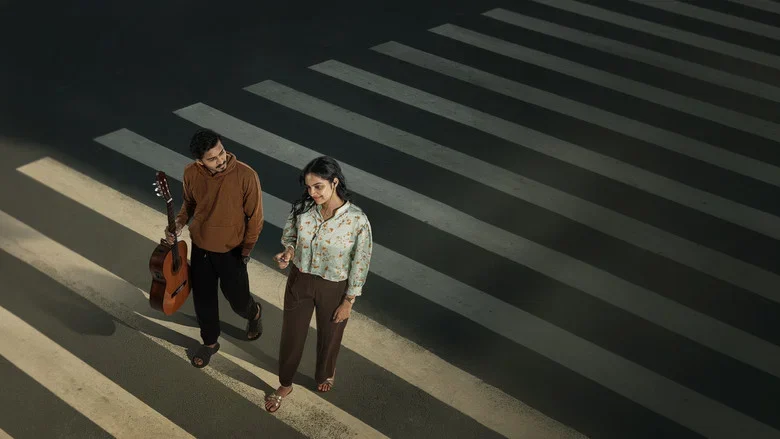
The lights go out across a Chennai apartment block, and two strangers are left on a terrace with nothing but each other and the hum of a generator. Eashwar Gopala Krishnan’s chamber drama bets everything on that enforced proximity.
It is a gamble that produces a handful of genuinely lovely textures and a great deal of air where a spine should be.
A Power Cut Is Not Yet a Plot
Sacchin Nachiappan plays a freelance illustrator, a man whose working life has curdled into drift. MV Namritha is the struggling music director who shares his terrace and, eventually, his evening.
The premise is elegantly economical. Darkness strips away screens and small talk, and the script asks us to believe that honesty rushes into that vacuum.
What the film never quite solves is why these two specifically need each other tonight. Loneliness is the stated antagonist, but loneliness is a condition, not a scene engine.
Where the Silence Earns Its Keep, and Where It Doesn’t
The film’s early passages are its most disciplined. Gopala Krishnan stages the first minutes as a study in bodily awkwardness, two people occupying opposite corners of a concrete slab, each pretending the other is scenery.
Namritha’s music director fidgets with a phone that has no signal, then sets it face-down with a small, defeated precision. It is the evening’s best single gesture.
Then the talking starts, and the film’s grip loosens. The dialogue reaches for profundity and lands on the general, and the blackout begins to feel less like a dramatic pressure cooker than a scheduling convenience.
This is the trap that swallowed the more ambitious Kidney, where withholding information curdled into withholding momentum. Here the opposite error creeps in: the film explains its own melancholy instead of dramatizing it.
Two Performers Carrying a Room With Nowhere to Hide
Nachiappan has the harder job and the thinner material. His illustrator is written as recessive, and he plays the reticence with a pleasant, low-energy naturalism that never sharpens into need.
Watch his shoulders in the middle stretch, they stay squared, relaxed, unbothered, even when the conversation turns to career failure. A man describing his own creative paralysis should carry some physical residue of it.
Namritha is the more interesting presence. She listens with her whole face, and there is a flicker of real appetite when her character talks about a score she cannot finish.
It recalls the stranded-star melancholy of Dark Chocolate, another recent study of stalled ambition, though that film at least gave its protagonist a hallucination to argue with.
Arun Krishnan is listed in the cast, and I genuinely cannot tell you what he does here. No scene I can locate assigns him a function, which is itself a small indictment of how thinly the world beyond the terrace is drawn.
A City Reduced to Sound and Rim Light
The film’s real achievement is atmospheric. The terrace is lit in the last orange of sunset, then in the blue-grey spill of emergency lamps, and the city below shrinks to scattered windows and distant chatter.
It is a clean, legible visual idea: the city as a field of small private lives, all of them briefly unplugged at once.
AKR’s score is used sparingly, mostly as a low sustained tone under the longer silences, and the restraint is correct. The problem is that the camera has only two positions, wide two-shot and closer two-shot, and by the fortieth minute the grammar has exhausted itself.
Contrast the lean economy of Angelina, which understood that a single location demands a restless visual intelligence. This film’s stillness is sincere but static.
The Runtime Riddle and the Missing Third Act
Listings disagree on whether this runs forty-three minutes or a full hour, and the discrepancy matters more than it should. The version I sat through feels like neither, it ends just as the two characters arrive at something worth saying.
The final exchange gestures toward recognition without landing on a decision, an admission, or even a clear refusal. Ambiguity is a legitimate ending; vagueness is not.
What we get instead is a mood that outlasts its own argument. Two lonely people share a dark evening, and the lights come back on, and we are asked to find that sufficient.
A Micro-Budget Bet in a Market That Rewards Scale
There is no verifiable production banner attached to this release, which tells its own story about how a film like this reaches a screen. It arrives as a limited Tamil title without the marketing scaffolding that even modest theatrical dramas now require.
The commercial math is unforgiving. A forty-odd-minute chamber piece with no star leverage and no franchise hook is essentially unmarketable in a theatrical ecosystem built on event releases.
Its realistic afterlife is streaming, where its brevity becomes an asset rather than a liability. That is not a failure of ambition so much as a mismatch between form and distribution.
The broader shift toward patient, character-led Tamil storytelling is real, and it is being watched closely across contemporary Tamil dramas. But patience still has to be earned scene by scene.
The Verdict
Sooriyan Maraindha Maalai is a film of genuine sensitivity and insufficient construction, a blackout that never quite becomes a story.
Its best moments are small and physical: a phone set face-down, a pause held just past comfort, the blue wash of a generator lamp on concrete. Its worst are the ones that explain.
Gopala Krishnan has an eye and a temperament. What he does not yet have is the willingness to make his characters want something badly enough to damage themselves reaching for it.
Until then, the lights come back on, and the evening evaporates.
Explore Cinema Hubs

Recommended for You

Poniiy (2026): Kunal Singh and a Missing-Owner Mystery That Never Quite Bites
Shibesh Motilal opens on a dog that belongs to two households at once, and a girl who decides that arithmetic is intolerable.…

Little Thomas (2026): Hridansh Parekh Anchors a Gentle, Single-Track Goa Memory
Kaushal Oza opens on a seven-year-old’s face in Fontainhas, and the film’s whole gamble is written there: a child solving adult sadness…
Unmadham (2026): Kunchacko Boban Anchors A Mystery That Loses Its Grip
Kunchacko Boban walks through the first half of Unmadham with a quiet intensity that suggests something dangerous is coiled beneath the surface.…