Dark Chocolate (2026): Vishwadev Rachakonda’s Fading-Star Hallucination Thriller Runs Aground on Its Own Ambiguity

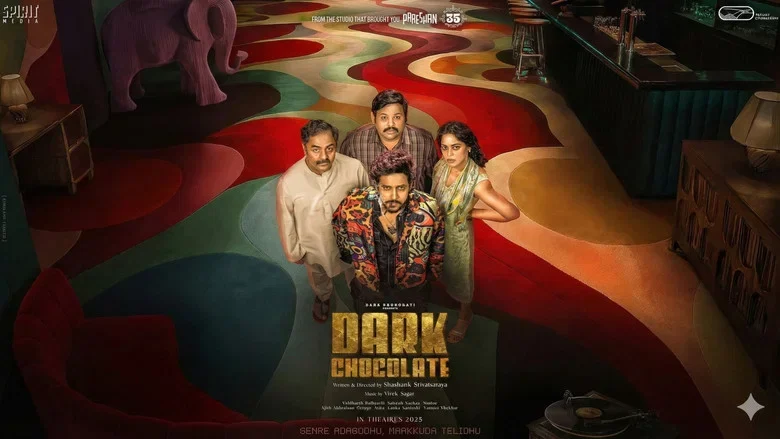
A mansion, three summoned guests, and a host who insists they are figments of his imagination. Shashank Srivatsavaya’s psychological thriller sets a fascinating trap and then forgets to spring it.
When The Protagonist Declares His Own Guests Fictional, Every Scene Gains A Double Floor
Fire Star Yagna, played by Vishwadev Rachakonda, is a former matinee idol whose career has cratered after a string of flops and public humiliation.
He assembles three influential figures from his past inside an isolated house, pitches the reunion as a comeback maneuver, and then calmly announces they do not exist. The room destabilizes instantly.
It is a genuinely audacious premise. The conflict is not a rival or a crime syndicate but a man’s own collapsing perception, and the screenplay commits to that uncertainty with a stubbornness that deserves respect even when it frustrates.
The Comedy Keeps Sabotaging The Dread Itself Is Trying To Build
The film is billed as a comedy and a psychological thriller, and those two registers never negotiate a truce.
Yagna’s arrogance is played for laughs in the early stretch, with a certain theatrical vanity in how he stages the mansion gathering and preens before guests he simultaneously claims are imaginary.
But when the night curdles and the hallucinations intensify, the comic muscle memory keeps twitching at moments that need silence. Vivek Sagar’s score strains to hold the tonal line, yet the film keeps pulling back from the abyss just as it starts to get uncomfortable.
What the screenplay achieves, however, is a genuine thematic stake. Yagna’s professional ruin gives the delusion machinery a concrete anchor rather than a floating art-house conceit, and the story treats fame as a wound that reopens every time he looks at his own reflection.
Rachakonda Carries The Film On His Shoulders, But The Script Gives Him Little To Push Against
The central performance demands a specific and punishing double register: every line Yagna speaks must function as deliberate manipulation and as symptom.
Rachakonda finds real menace in the stillness. When he calmly informs his guests they are products of his imagination, the delivery lands with a controlled flatness that is far more unnerving than shouting would be.
Later, as he moves through the mansion’s corridors trying to eliminate the figures he believes obstruct his comeback, there is a physical restlessness in his gait that suggests a man pacing the perimeter of his own mind.
The problem is the material around him. The psychological pressure that should come from the supporting figures is largely absent; they exist as props for Yagna’s unraveling rather than as presences that push back.
Bindu Madhavi registers clearly as Hamsa, and there is a watchfulness in her stillness during the early confrontation that hints at a richer character than the screenplay provides. But the film never gives her a sustained scene to convert that watchfulness into dramatic friction.
The remaining cast, Rakesh Rachakonda and Ramesh Konambhotla among them, are stranded in functional roles that require them to react rather than resist.
A Confined Mansion Should Generate Pressure, Not Repetition
Shashank Srivatsavaya, who also writes and edits, has built a film around restricted geography, and the mansion should function as a pressure cooker. Instead, it becomes a loop.
The first half moves efficiently through the setup: the career collapse, the invitation, the declaration, the first crack in reality’s facade. The second half is supposed to escalate through hallucinations and competing versions of events, but the escalation is largely rhetorical.
Characters argue about what is real. The camera moves through corridors. Strange incidents accumulate. Yet the film rarely dramatizes the destabilization it keeps describing, and the repetition starts to feel like a structural crutch rather than a deliberate descent.
Sathish Saakar’s cinematography is competent but anonymous. The lighting stays flat through sequences that should be sculpted in shadow, and the mansion’s spaces are framed with a functional evenness that drains tension rather than concentrating it.
The Final Confrontation Raises The Right Questions And Then Refuses To Answer Them
The climax forces Yagna to confront the reliability of his own perception, which is the correct destination for this kind of story.
But the film mistakes vagueness for depth. Ambiguity in psychological thrillers only works when the competing interpretations are both fully realized and genuinely dangerous; here, the uncertainty feels less like a designed trap and more like a refusal to commit.
There is no verified critical consensus to lean on, and the film’s theatrical run has barely begun, but the structural problem is visible on screen. The screenplay builds a labyrinth and then declines to place the minotaur anywhere inside it.
This is a film that wants to be discussed after the credits roll, and there is genuine ambition in that. But conversation requires something concrete to argue about, and Dark Chocolate too often offers only atmosphere where it needs a verdict.
The tonal tightrope it attempts is not unprecedented in the current wave of contemporary Telugu thrillers, but the films that succeed in this register commit harder to either the comedy or the dread.
Spirit Media And Waltair Productions Are Betting On A Star Vehicle Without A Star Vehicle’s Safety Net
The producing banners, Spirit Media and Waltair Productions, have backed a contained-location psychological piece in a market that rewards scale and spectacle.
Rana Daggubati’s involvement as producer signals an appetite for mid-budget experimentation, and the film’s A certificate and narrow premise position it as an adult-skewing theatrical proposition rather than a mass-market event.
For Vishwadev Rachakonda, this is a genuine leading-role gamble after a career built largely on supporting turns, and the box-office math is unforgiving.
The film’s commercial ceiling depends on word-of-mouth from viewers who want to argue about endings, and that audience is real but finite.
The comparison to other recent Telugu experiments is instructive. Lambodhara 2.0 arrived with a clearer tonal contract, and KillR at least committed to its own fragmentation as a formal strategy rather than a side effect.
Dark Chocolate sits between those poles, wanting the intellectual credibility of a puzzle box and the accessibility of a comedy, and fully delivering neither.
The Verdict: A Promising Trap That Never Quite Snaps Shut
There is a version of this film that is genuinely unsettling, one where the mansion’s walls close in and Yagna’s certainty curdles into something genuinely frightening.
That version is visible in flashes, particularly in Rachakonda’s controlled early scenes and in the premise’s willingness to make its protagonist the source of his own horror.
But the film’s refusal to commit, tonally and structurally, leaves it stranded between registers. It is neither funny enough to disarm nor frightening enough to disturb, and its ambiguity reads as evasion rather than design.
The closing image lingers longer than the film has earned, and that is the real disappointment. A story about a man who cannot trust his own perception should leave the audience equally uncertain, but Dark Chocolate mostly leaves them waiting for a punchline that never arrives.
Explore Cinema Hubs

Recommended for You

Haiku (2026): Aegan’s Possessive Lover Drama Fails to Narrate Its Own Idea
The first male student walks into a women’s college in Coimbatore, and the film’s best idea is already spent on the doorway.…
Arjunan Per Paththu (2026): Yogi Babu’s Earnest Shift Anchors A Familiar Crime Drama
The theft happens fast, but the wound stays open. Arjunan, a working man played by Yogi Babu in a strikingly serious register,…
Governor (2026): Manoj Bajpayee Anchors Nation’s Economic Reckoning
India teeters on bankruptcy’s edge as fuel shortages spread panic and inflation devours the economy whole. A reluctant bureaucrat named A. Ramanan…