Comrade Kalyan (2026): Sree Vishnu’s Double Act Can’t Hold a Fractured Revolution

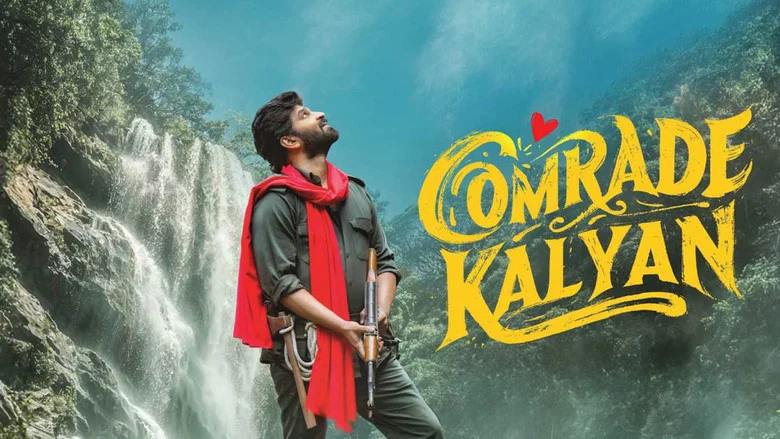
The film opens in 1992 on the Andhra–Odisha border, where a local theatre owner named Kalyan (Sree Vishnu) grins his way through a public life of small-town frivolity. His mother (Raadika Sarathkumar) is a Balakrishna devotee whose fandom plays as sitcom texture. Janakiram Marella’s camera lingers on the warmth of that domesticity with an almost suspicious tenderness. We know the smile is a mask because the trailer already told us, but the film takes its time letting the mask crack. That patience is both its most confident gesture and its eventual undoing.
A Language Barrier That Works Until It Doesn’t
Kalyan falls for an Odisha woman (Mahima Nambiar), and their romance is built entirely around the comedy of two people who cannot speak each other’s languages. It is a genuinely clever conceit for the first hour, every misunderstanding is a small act of theatre, and Vishnu plays the frustration with a loosened jaw and a shrug that lands somewhere between charm and defeat. But the screenplay never deepens the joke into anything more painful. The barrier remains a gag when it should become the emotional wound the film keeps promising.
Sree Vishnu’s Split Performance Is The Film’s Real Engine
The pivot from cheerful theatre owner to most-wanted Naxalite is the hinge on which everything swings, and Vishnu handles the transition with a physical economy that deserves more than the screenplay gives him. Watch his shoulders in the reveal sequence, the easy slouch of the earlier scenes straightens into something coiled and watchful, and his voice drops a register without ever tipping into theatrical menace. It is a performance built on what he withholds. That control recalls the quiet interiority he brought to Your's Sincerely RAAM, where memory and restraint did the work that dialogue refused to do.
The Manhunt Arrives, But The Tension Doesn’t
Once the police pursuit kicks in, the film shifts into procedural mode, Shine Tom Chacko’s Kerala officer brings a welcome institutional chill to the border conflict, and his scenes crackle with the kind of bureaucratic menace the rest of the film lacks. But the gang members played by Satya and Sudarshan exist almost entirely to puncture tension with comic relief, and the strategy backfires. Every time the pursuit tightens, a joke loosens it. The kidnapping of the powerful politician should be the film’s tightening noose, but the staging feels oddly weightless, the demand for imprisoned comrades is stated, not felt.
Where The Craft Holds And Where It Slips
Sai Sriram’s cinematography does its best work in the border terrain, where the flat light of the Deccan plateau gives the pursuit scenes a documentary plainness that suits the period. Vijay Bulganin’s score, however, keeps reaching for grandeur the images haven’t earned. The editing in the first half is patient to a fault; the second half rushes the hostage operation past its own dramatic logic. The film wants to be both a romance and a political thriller, and Marella never quite decides which one gets the final word. The tonal wobble is not fatal, but it is persistent.
The Uncomfortable Cost Of A Double Life
What the film gets right, in its best moments, is the private cost of political violence. Kalyan’s mother remains oblivious, his lover remains linguistically adrift, and his comrades remain loyal to a cause the film never fully interrogates. The climax resolves the hostage standoff with a neatness that feels unearned given the moral mess the film has spent two hours accumulating. This is a film that wants to have its revolutionary cake and eat its romantic dessert too. The peer release Toxic suffered from a similar structural generosity, strong openings, soft landings, and Comrade Kalyan repeats the pattern with more ambition but comparable uncertainty.
The Genre Sibling That Got The Ritual Right
Where this film stumbles is in its failure to commit to the political thriller’s cold logic. The contemporary Telugu thriller Maremma understood that atmosphere without consequence becomes tedium, and it at least committed to its own dread. Comrade Kalyan hedges, it wants the warmth of romance and the edge of insurgency, and it ends up with neither fully. The 1992 border setting is a gift the screenplay never unwraps. As a piece of contemporary Telugu thrillers, it registers as an ambitious misfire rather than a failure of craft.
The Verdict: A Revolution That Forgets Its Own Stakes
Comrade Kalyan is a film of two halves that never quite agree on what they are building. Sree Vishnu’s performance is the strongest argument for its existence, a study in controlled duplicity that deserves a sharper screenplay. The romance charms, the politics gestures, and the thriller mechanics function without ever truly threatening. It is a film that understands the shape of its own drama but not the weight of it. Rating: 2.5 / 5
The final image of Kalyan, a man who has spent the entire film being two people at once, lands with a quiet that the preceding two hours have not prepared us for. It is the only moment the film trusts its own silence. If only it had trusted it sooner.

Recommended for You
Oh..! Sukumari (2026): A Rural Comedy That Never Finds Its Rhythm
The opening stretch of Oh..! Sukumari introduces Yadagiri (Thiruveer) as a village innocent whose romantic entanglement with Damini (Aishwarya Rajesh) promises the…

Max, Min and Meowzaki (2026): Vil Huss and stands out while the narrative loses grip
Two people sit opposite each other, their shared life laid out on a table, and the argument spirals into who gets the…
Ikka (2026): Sunny Deol Anchors stands out while the narrative loses grip
The courtroom goes silent as Sunny Deol’s Arjun Mehra, the man who never loses a case, locks eyes with Akshaye Khanna’s Shauryaman…