Baththa (2026): Vijay Sethupathi Anchors A High-Concept Premise That Tests Patience

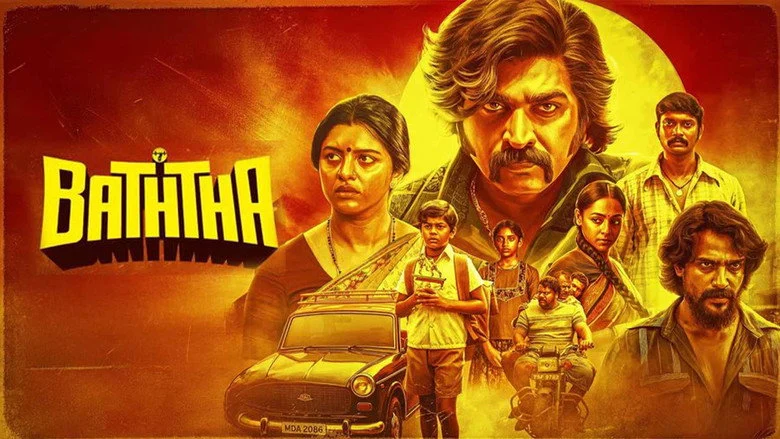
Balaji Tharaneetharan has never been a filmmaker interested in the obvious. The director behind Naduvula Konjam Pakkatha Kaanom and Seethakaathi has built a reputation for taking absurdist premises and mining them for unexpected emotional depth. With Baththa, he reunites with Vijay Sethupathi, a collaboration that arrives with considerable anticipation given their shared history in Tamil cinema’s more adventurous corners, and drops a feared 1986 Madras gangster into a deserted school restroom, courtesy of an eight-year-old boy’s accidental mischief.
It’s a premise that sounds like a punchline searching for a punch. And for roughly the first hour, Baththa threatens to become exactly that: a one-joke conceit stretched across a punishing 170-minute runtime.
When The Setup Outstays Its Welcome
The film’s central mechanism, a powerful man rendered powerless by circumstance, is rich territory. Sethupathi’s gangster, introduced with the kind of swaggering menace that has become the actor’s signature, finds his authority evaporating the moment that restroom door clicks shut. Tharaneetharan stages this reversal with deliberate pacing, allowing the character’s initial fury to curdle into confusion, then hunger, then something approaching genuine introspection.
The problem is that the film mistakes duration for depth. What should be a taut examination of masculinity stripped bare becomes a repetitive cycle of the gangster pacing, shouting, and eventually bonding with his young captor. The child, performed with naturalistic ease by Sahasra Sree, serves as both plot device and thematic mirror, but the screenplay never quite figures out how to make their conversations feel earned rather than engineered.
There’s a sequence roughly forty minutes in where the gangster attempts to negotiate his release through the restroom’s narrow ventilation window. The staging is claustrophobic in ways that suggest Tharaneetharan understands the visual potential of his setting, the camera pressed close, the sound design amplifying every echo, but the dialogue that follows undercuts the tension with exposition that feels imported from a different, more conventional film.
Vijay Sethupathi’s Committed Performance Meets A Structural Wall
To be clear: Sethupathi is doing serious work here. The actor has always excelled at finding the wounded humanity beneath tough exteriors, his performances in films like Super Deluxe and Vikram Vedha demonstrate an instinct for moral complexity that few of his contemporaries can match, and Baththa gives him ample opportunity to oscillate between menace and vulnerability.
Watch the scene where he describes his family to the child. It’s a monologue delivered while crouched against a tiled wall, the fluorescent light casting unflattering shadows across his face. Sethupathi doesn’t play the moment for sympathy; instead, he lets the character’s confusion about his own tenderness register as genuine bewilderment. It’s a reminder that this is an actor who can find nuance in almost any material.
But the material here doesn’t always deserve him. The screenplay, also by Tharaneetharan, struggles to externalize the gangster’s internal transformation in ways that feel organic. The 1986 Madras setting, recreated with evident attention to period detail, functions more as aesthetic window-dressing than as a living, breathing world that shapes the characters’ choices. The vintage crime-world texture is present, but it rarely intersects meaningfully with the film’s central confinement drama.
For a more successful example of a high-concept Tamil film that balances commercial appeal with narrative discipline, our review of Vibe review examines how that spy caper similarly struggles with tonal consistency across its runtime.
The Child Bond That Never Quite Clicks
The emotional core of Baththa rests on the developing relationship between the gangster and his young captor. In theory, this is fertile ground: two people from vastly different worlds forced into proximity, each learning something about the other’s humanity. In practice, the film’s treatment of this bond feels schematic rather than organic.
The child character is written with a precociousness that borders on implausibility. His dialogue, alternating between childish innocence and surprisingly philosophical observations, suggests a writer more comfortable with ideas than with actual children. When he asks the gangster why people are afraid of him, the question lands not as a child’s genuine curiosity but as a thematic signpost the film has been building toward.
Lijomol Jose, as the female lead, is given frustratingly little to do. Her character exists primarily to provide context for the gangster’s home life, appearing in flashbacks that feel like obligations rather than integral narrative threads. The actress, so compelling in Jai Bhim, deserves more substantial material than this.
The film’s handling of its ensemble, Ajay Ghosh, Arjun Chidambaram, Hari Krishnan, and Santhy Balachandran all appear in supporting roles, reflects a broader issue: Baththa has assembled considerable talent but struggles to integrate them into a coherent whole. Characters drift in and out of the narrative without leaving much impression.
Where The Film Finds Its Footing
And yet, there are moments, particularly in the final act, where Baththa achieves something approaching the emotional resonance it’s clearly reaching for. As the gangster’s confinement nears its end, the film allows itself to sit with the character’s transformation rather than rushing toward resolution. The climax, while predictable, is staged with a restraint that suggests Tharaneetharan understands the power of understatement.
The technical craft is consistently solid. The cinematography captures the period setting with warm, textured lighting that evokes the era without resorting to nostalgic clichés. Sai Abhyankkar’s score, though not particularly memorable, serves the film’s tonal shifts adequately. The editing, however, could have been more ruthless, trimming even twenty minutes from the runtime would have sharpened the film’s impact considerably.
For those interested in how Tamil cinema has approached similarly ambitious narrative structures, our analysis of HALF verdict offers another perspective on the challenges of balancing commercial expectations with artistic aspiration.
The Verdict: A Promising Premise Undone By Indulgence
Baththa is a film that arrives with considerable pedigree and leaves with diminished returns. Balaji Tharaneetharan’s willingness to take risks remains admirable, there’s something refreshing about a mainstream Tamil film that trusts its audience to sit with a single location and a character’s internal transformation, but good intentions don’t excuse a screenplay that confuses repetition for depth.
Vijay Sethupathi delivers committed work, as always. His performance alone provides enough reason for his devoted fans to seek this out in theaters, and the 1986 Madras setting offers a visually distinctive backdrop. But the film’s structural problems, the bloated runtime, the underdeveloped supporting characters, the child bond that never quite convinces, prevent it from achieving the emotional resonance it clearly aspires to.
This is a film best approached with tempered expectations. Those seeking a character-driven drama with a unique premise will find elements to appreciate, particularly in the third act. Those hoping for a taut thriller or a return to the sharp writing of Tharaneetharan’s earlier work should prepare for disappointment.
As we frequently examine across Tamil Action reviews, ambition alone doesn’t guarantee execution. Baththa is proof that even the most intriguing premise requires disciplined storytelling to fully realize its potential.
Rating: 2.5/5
Baththa is now playing in theaters.

Recommended for You

Toxic: A Fairy Tale for Grown-ups (2026): The Opening Scene gives the film energy despite weak payoffs
The first glimpse of Raya is pure spectacle. Yash towers over the frame, the Goa underworld bending to his will as the…

Sathyavan Savithiri: A Courtroom Drama That Rests on Keerthy Suresh’s Shoulders
The teaser places us inside a sterile courtroom, where the camera lingers on the polished wood of the benches before settling on…
Hum Angrezon Ke Zamane Ke Jailor Hai (2026): Asrani’s Nostalgia Play Stumbles on Narrative Clarity
A murder mystery unfolds within the confines of family dispute and criminal escalation, with investigators Dev and Rana tasked to unravel layers…