Mookuthi Amman 2 (2026): Nayanthara’s Divine Double Act Frays Under Sundar C’s Two-Timeline Bloat

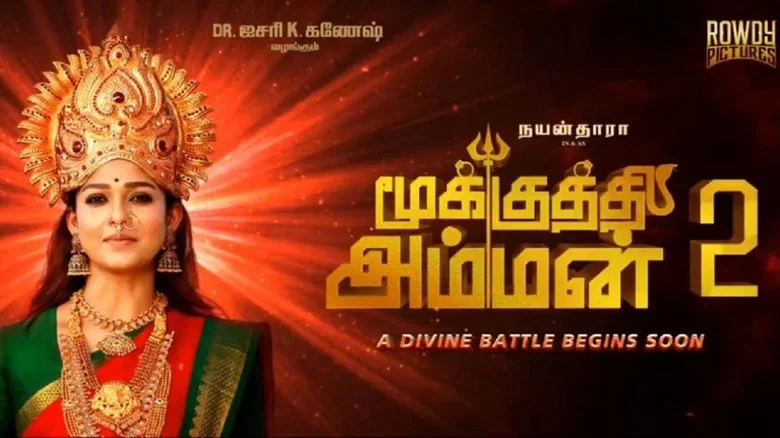
The opening night crowd at the Diwali screening came for the goddess and stayed for the cop. Sundar C’s sequel arrives with a mythology twice as large and a script half as certain about what to do with it.
Two Timelines, One Goddess, And A Structural Bet That Nearly Breaks
The film opens in a period register of ritual and dread: two supernatural forces massing for a clash that threatens to tear the world open. A queen’s sacrifice to shield her young prince anchors the sequence in devotional gravity, and for fifteen minutes the screen holds genuine mythic weight.
Then the film cuts to the present, and the engine changes entirely. A frightened police constable, Nayanthara, in the film’s second and more interesting register, stumbles into a supernatural conflict she cannot comprehend.
That collision between ancient sacrifice and contemporary panic is the film’s central bet. When it works, the contrast is electric; when it doesn’t, the exposition sags under its own ceremonial weight.
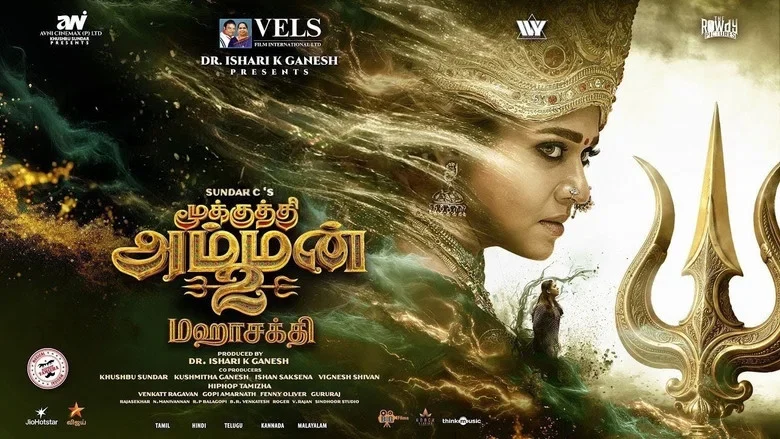
The Dual Role Is The Film’s Best Idea And Its Most Underwritten
Nayanthara’s goddess arrives with the expected authority: chin lifted, voice dropped to a measured register, stillness used as a weapon rather than a pause. Her constable, by contrast, flinches at shadows and clutches her lathi like a talisman.
The performance distinction is real, and it recalls the disciplined register she brought to the supernatural register of Toxic, where controlled physicality carried the role. Here, though, the script gives the timid officer long stretches of reaction without agency.
She spends the middle act being explained to. The goddess does the fighting; the constable does the trembling. That asymmetry is the screenplay’s quiet failure, the human half of the dual role never earns the revelation it’s handed.

Regina Cassandra Brings A Real Antagonist, And The Film Wastes Her
Regina Cassandra’s dark sorceress is the film’s most confident piece of casting. She plays the antagonist with a flat, unhurried vocal delivery and a physical stillness that reads as genuine menace rather than theatrical villainy.
The problem is that the screenplay treats her as a destination rather than a character. Her objective remains a blur; her connection to the ancient conflict is gestured at rather than dramatized.
By the time the goddess-versus-sorceress confrontation arrives, the stakes are stated in dialogue rather than felt in the body. That is a writing problem, not a performance one.
Sundar C Controls Scale But Not Tone
The director’s strength is spatial: the period-world imagery is staged with wide, cold compositions that make the mythological threat feel larger than the frame. The present-day sequences tighten into close, handheld proximity, and the visual contrast between the two worlds is legible from the first cut.
Where the film slips is in the seams. The transitions between devotional drama, comedy, and police procedural are abrupt rather than organic, and the supporting ensemble is left to fill the gaps with broad strokes.
Urvashi and Yogi Babu appear in the expected comic registers, but their set-pieces land as interruptions rather than releases. The tonal machinery never quite synchronizes.
The screenplay resists the kinetic sensationalism that overtook Nayyi Navelli, opting instead for a deliberate, ceremonial dread. That restraint is admirable, but it also exposes how thin the connective tissue between the timelines really is.
The Climax Promises A Universe It Hasn’t Earned
The final act stages the divine confrontation with genuine visual scale, and the closing beat hints at three additional divine entities entering the conflict. It’s a franchise-building flourish, and it lands with a thud.
You cannot tease a pantheon when the first goddess-versus-sorceress battle hasn’t resolved its own emotional stakes. The cliffhanger reads as a promise the film hasn’t paid for.
The two-and-a-half-hour runtime compounds the problem. By the final reel, the film has spent its credibility on exposition, and the escalation feels like arithmetic rather than revelation.
Avni Cinemax And Rowdy Pictures Are Betting On Devotional Fantasy As A Franchise
The producing banners, Avni Cinemax, Rowdy Pictures, Vels Film International, are clearly positioning this as a Diwali tentpole with franchise ambitions. The pre-release advance bookings, reported at roughly ₹4.27 crore across six show dates, suggest the market is willing to show up.
But the commercial math is fragile. Devotional fantasy in Tamil cinema has a loyal base, yet the sequel pipeline depends on repeatable spectacle rather than one-off mythological novelty.
Nayanthara’s box-office leverage remains considerable, but a dual role that splits her screen time between divine authority and human passivity dilutes the very star wattage the film is selling.
The comparison to the more contained Disco is instructive: that film knew its scale and stayed inside it. This one reaches for a universe before it has secured a single compelling story.
Whether the sequel model holds depends on whether audiences reward ambition over coherence. The early signs suggest they might, but not indefinitely.
This patient mythological expansion signals a broader appetite across contemporary tamil fantasys, where scale is increasingly the selling point and narrative discipline the casualty.
The Verdict: A Divine Spectacle That Forgets Its Own Mortal Heart
Mookuthi Amman 2 is at its best when it remembers that the constable is the audience’s surrogate, the frightened human who has to believe before the goddess can act. It forgets that far too often.
Nayanthara’s dual performance is the film’s strongest asset and its most squandered one. Regina Cassandra deserved a script that gave her a motive rather than a menace.
Sundar C has built a temple large enough for a pantheon. He just hasn’t figured out which god to pray to first.
Explore Cinema Hubs

Recommended for You
LURK (2026): Saiju Kurup Stuck lands hard though the screenplay stays patchy
The forest is dense, the stakes are life-and-death, but Saiju Kurup’s performance in Lurk feels like it is fighting a different enemy:…
Alpha (2026): A Tattoo That lands hard though the screenplay stays patchy
The opening scene of *Alpha* (2026) does not waste a second. Alia Bhatt’s protagonist walks home from a party, rolls up her…

Toxic: A Fairy Tale for Grown-ups (2026): The Opening Scene gives the film energy despite weak payoffs
The first glimpse of Raya is pure spectacle. Yash towers over the frame, the Goa underworld bending to his will as the…