Kitti (2026): Ashok Kumar Balakrishnan Anchors a Confession Thriller That Forgets to Interrogate

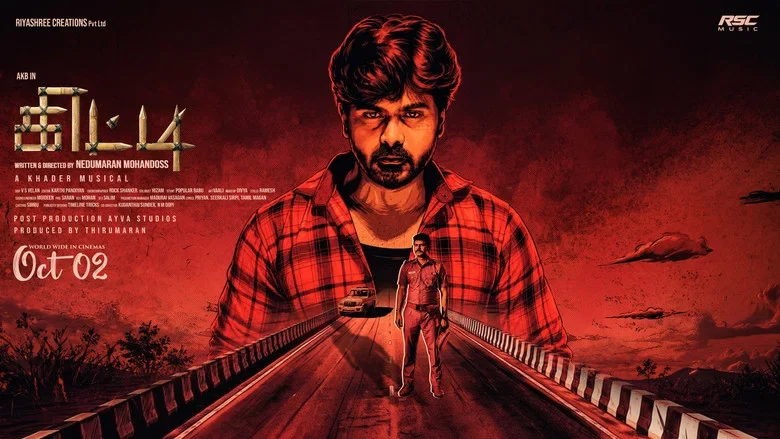
The auto-rickshaw driver walks into the station and says he did it. Two bodies, he claims, are on him. No chase, no forensic montage, no body discovered by a jogger. Nedumaran Mohandoss opens Kitti by handing the audience a confessed murderer before he hands them a crime, and for roughly twenty minutes that inversion works: the question stops being who and becomes why is this man so eager to be arrested? It is the rare Tamil thriller that treats a police-station threshold as a dramatic location rather than a formality.
Then the film spends the next hundred minutes answering a question it already asked, and the air goes out of it.
A Confession Is Only as Strong as the Interrogation That Follows It
Inspector Rajapandiyan, played by producer Thirumaran Mohandoss, is the film’s procedural counterweight: he takes the statement, cross-checks the details, and slowly suspects that Vijay’s account is either incomplete or internally inconsistent. That is the correct engine for this subgenre. The problem is that the screenplay treats Rajapandiyan as a receptacle for exposition rather than an adversary with his own stake in the outcome.
Watch how the interrogation scenes are staged. Thirumaran sits largely still behind the table, delivers his lines at a single register, and waits for the next plot beat to arrive. There is no escalating pressure in his body, no shift in how close he leans, no moment where the room’s power balance visibly tilts. Compare that to the spatial discipline on display in Toxic, where the camera’s refusal to leave a room does the work the dialogue won’t. Kitti keeps cutting away, to flashback, to street, to a second location, precisely when the tension needs to be compressed into a single chair.
Ashok Kumar Balakrishnan Is Doing Something Real in a Film That Won’t Sit Still For It
The lead performance is the reason to buy a ticket, and it is also the reason the film’s failures sting. Ashok plays Vijay’s surrender with a flatness that reads as deliberate: minimal eye contact, hands kept loose at his sides, a voice that never rises to plead. He is not performing innocence or guilt. He is performing a man who has already decided something, and that decision is the only thing holding him upright.
Later, when the script requires him to shift registers, the ordinary working man, the alleged double murderer, the unreliable narrator, he does it with small physical adjustments rather than actorly display. A slackening around the mouth. A blink held a beat too long. The role’s demands are closer to what Anjali Patil pulls off in Selvi, where the performance lives in what the character refuses to say, than to anything the thriller plotting around him is equipped to support.
Which is the central frustration: the film casts a lead capable of ambiguity, then resolves his ambiguity with exposition.
The Second-Half Twist Machine Grinds Against Its Own Suspense
Promotional coverage sold the film on the promise of questions in the first half and reversals in the second, and that structure is audible in the finished product. The first hour withholds. The second hour pays out, and pays out, and pays out again, until the reversals stop functioning as revelations and start functioning as corrections, the film telling you that what you just watched was not what you thought.
There is a version of this where the unreliability is the point, where Vijay’s perception is genuinely in question and the audience is made to mistrust its own footing. The screenplay gestures at that. It does not commit. Every time the film introduces doubt about what Vijay saw or did, it resolves the doubt within the same sequence, usually with a line of dialogue that explains the previous scene rather than complicating it.
The thematic ambition is legible: love, revenge, and a social grievance folded into a murder case, which is the same tripartite structure that gives Enna Vilai its moral weight. But that film lets the social machinery grind slowly and lets the audience feel the cost. Kitti name-checks its social issue and moves on.
The Supporting Cast Is Mostly a Casting List, Not a Dramatic Force
This is where the film’s thinness becomes structural rather than incidental. Pooja, the college student whose death triggers the investigation, is a victim before she is a person, she exists in the screenplay as a name in a confession, and the film never grants her a scene that establishes who she was. The judicial figure who appears late in the proceedings arrives with no established relationship to anyone in the story, which makes his presence feel like a plot requirement rather than a consequence.
A thriller can survive an underdeveloped victim. It cannot survive an underdeveloped investigator, and Rajapandiyan never becomes more than the man asking the next question. There is no visible cost to him pursuing this case, no personal history that makes Vijay’s confession land differently on him than it would on any other officer. He is procedure wearing a face.
Where the Craft Holds and Where It Doesn’t
The technical package is competent without being distinctive. Venkatachalam Singaravelan’s camera favors medium shots in the interrogation room, which keeps both men in frame and prevents the scene from becoming a talking-heads exercise, a reasonable choice, though it also means the audience is never placed inside Vijay’s head at the moment his account starts to fracture. A closer, more subjective lens in those sequences would have done more for the reality-versus-imagination premise than any line of dialogue.
Karthi Pandiyan’s editing is where the pacing problem lives. The first half moves with genuine purpose; the second half cuts faster in proportion to how much the script needs to explain, so the acceleration reads as anxiety rather than momentum. Sheik Khader’s score is present throughout but rarely earns its cues, the music tells you a twist has landed before you’ve had time to register that you should be surprised.
None of this is amateurish. It is simply unpressured, which is a worse problem for a psychological thriller than visible incompetence, because competence at least produces friction.
The Ending Resolves the Case and Abandons the Question
When the film finally accounts for Vijay’s confession, it does so cleanly. Motive is supplied. The connection between the two deaths is made legible. The social grievance that the screenplay has been carrying gets its moment. And in resolving all of it, the film quietly concedes that it was never really about perception at all, it was about a reveal, and the reveal has now been delivered.
That is the loss. Ashok built a performance around a man whose interiority was genuinely uncertain, and the script’s final act closes that uncertainty like a file. What could have been a study of a mind that cannot be trusted becomes a case that can.
There is a real appetite right now for Tamil thrillers that trust their audiences to sit inside discomfort rather than be walked through it, and that appetite is visible across contemporary tamil thrillers that have made ambiguity their house style. Kitti has the right lead, the right premise, and the wrong instinct: it wants to be understood more than it wants to be felt.
See it for Ashok, who is doing the hardest work in the film and doing it well. Go in knowing that the movie around him keeps explaining what he has already shown you.
Rating: 2.5 / 5
The confession was the hook. The explanation was the mistake.

Recommended for You

Haiwaan (2026): Priyadarshan’s Craft Holds While His Thriller Slips
Sound arrives before sight in Haiwaan, and Priyadarshan leans into that idea with real craft. A blind caretaker maps a room by…
Sweet Rogue Killer (2026): Karthick Ravichandran s lands hard though the screenplay stays patchy
A lone figure stands amidst the rubble of what was once the Forelli empire, his silhouette cutting against the smoke of a…
Lakshmikanthan Kolai Vazhakku (2026): Arivumathi s Burden lifts key stretches, not the full runtime
The courtroom is a battleground of words in Dayal Padmanabhan’s Lakshmikanthan Kolai Vazhakku, where a late twist involving Brigida Saga’s Mallika suddenly…