Nayyi Navelli (2026): Yami Gautam’s Daayan Bride Comedy Sags Under Its Own Folklore

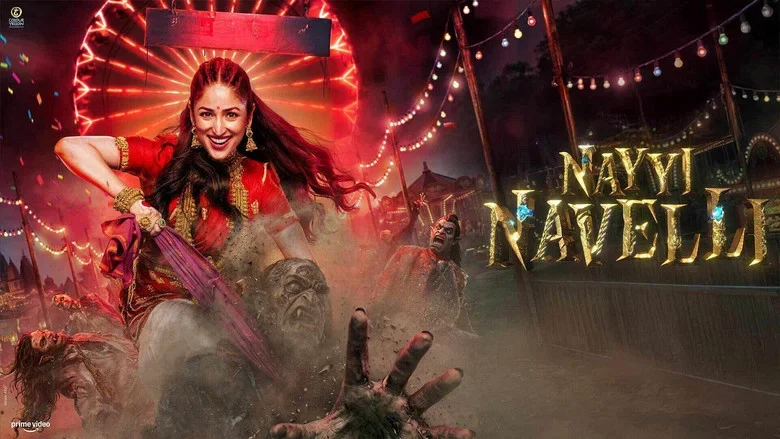
The most unsettling image in Balaji Mohan’s Meerut-set fantasy comedy isn’t a reversed footprint or a flickering tube light. It’s the sight of an entire joint family exhaling in unison because one woman has finally organised their kitchen.
That’s the cruel joke at the centre of Nayyi Navelli, and for roughly one act, it lands with genuine snap.
A Perfect Bride As Domestic Infrastructure
Yami Gautam Dhar enters as Mohini, and the film’s best idea is structural rather than supernatural. She doesn’t haunt the haveli; she optimises it. Sour dough rises on schedule, Tau Ji’s medicines appear before he asks, and the household’s ambient chaos quietly dies.
Mohan shoots this transformation as a comedy of logistics. The camera holds on faces during the reorganising, not on objects, which means we watch suspicion being born in real time rather than being told about it.
The brother-in-law becomes the audience surrogate, and his scepticism is the film’s engine. He doesn’t fear the woman; he fears the efficiency. That’s a sharper comic premise than most Hindi fantasy vehicles bother to construct.
The Foot Inspection And Other Folk Rituals
The trailer’s most discussed beat arrives when he asks Mohini to display her feet, invoking the daayan belief that a witch’s footprint runs reversed. It’s staged as a family parlor game, which is exactly right.
Folk horror works best when the ritual is mundane enough to be embarrassing. Here, the test happens over chai, with relatives pretending not to watch, and the scene’s tension comes from social awkwardness rather than jump-scare grammar.
That restraint is where the film’s tonal ambition lives. It wants the daayan to be a household problem, not a mythology problem, and the writing keeps returning to that domestic register.
Where The Second Act Begins To Bloat
The trouble is escalation. Once suspicion becomes investigation, the screenplay starts repeating its own beats: another relative doubts, another ritual is proposed, another meal is interrupted. The comedy thins, and the mystery doesn’t thicken enough to compensate.
Runtime listings for the film conflict between roughly 138 and 158 minutes, and watching the middle stretch, you believe the longer number. Sequences that should be one scene play as two, and the ensemble’s chatter starts to feel like filler rather than texture.
Where a tighter film like Ranabaali at least committed to its period momentum, this one keeps circling the same drawing room, mistaking repetition for rhythm.
Yami Gautam’s Two Performances In One Body
Gautam Dhar is doing something genuinely interesting here. As Mohini, she plays warmth as a learned skill, holding eye contact a half-second too long, smiling before the joke lands, always slightly ahead of the room.
The performance only fully coheres when the film lets her drop the mask. Her posture changes first, spine straightening, hands going still, and the voice loses its sing-song Meerut lilt for something flatter and older.
It’s a more disciplined turn than the heightened register she carried through Toxic, though the film around her rarely earns the precision she’s offering.
An Ensemble That Never Becomes A Family
Mita Vashisht gets the best supporting moments as Pinky Bua, largely because she’s allowed to react rather than explain. Watch her during the foot inspection: she looks away first, then back, and the whole character arrives in that hesitation.
Sunita Rajwar’s Asha Devi, by contrast, is given dialogue that only restates what the plot has already established. The elder-generation relatives exist as a chorus of reactions rather than individuals with stakes.
That’s the screenplay’s central failure of imagination. A joint-family comedy lives or dies on the specificity of its members, and here most of them are interchangeable voices registering the same suspicion at different volumes.
The Reveal And What It Costs The Film
When Mohini finally drops her ideal-bride persona before the family, the staging leans on scale rather than intimacy. The camera pulls back, the score swells, and the moment becomes a set piece instead of a confrontation.
It’s the wrong instinct. The film’s power had been in proximity, in the unbearable closeness of a stranger living inside your home, and the climax trades that for spectacle it can’t sustain.
The final twist is designed to recontextualise everything, and it does so cleanly enough. But a twist that only rearranges plot furniture isn’t the same as one that deepens what the film was actually about.
That distinction matters more than the film seems to realise. A story built on the terror of domestic perfection should end by asking what the family was really afraid of, and the script settles for a cleverer answer than a truer one.
Direction, Pacing, And The Score’s Overreach
Mohan’s strongest directorial choice is what he refuses to show. For long stretches, the supernatural stays off-screen, and the film generates dread from ordinary domestic sounds: a pressure cooker, a ceiling fan, footsteps at the wrong hour.
Then the background score betrays him. Every moment of ambiguity gets underlined by strings, as if the film doesn’t trust its own silences, and the effect is a nervousness the material never needed.
The production design does better work. The Meerut household is cluttered, lived-in, and lit like a home rather than a haunted set, which keeps the fantasy grounded even when the writing drifts.
Amazon MGM And Colour Yellow’s Theatrical Gamble
Amazon MGM Studios and Colour Yellow Productions are betting on a specific audience: family viewers who want fantasy comedy with a folk-horror hook rather than a straight horror film. It’s a smart theatrical play on paper.
The problem is the marketplace. Hindi fantasy comedy has become a difficult theatrical proposition, squeezed between bigger franchise spectacles and streaming-friendly family dramas that never needed a ticket window.
For Yami Gautam Dhar, the film is a genuine test of solo theatrical pull. She’s proven reliable in ensemble and mid-budget contexts, but a film this dependent on her presence needs her to carry the opening weekend almost alone.
That’s a real commercial risk for a producer betting on original IP over the remake pipeline, and the film’s muddled middle act won’t help word-of-mouth spread past the first few days.
A Premise That Deserved Sharper Teeth
Nayyi Navelli has the bones of something genuinely subversive: a comedy about how a family’s gratitude curdles into paranoia the moment a woman becomes too competent. That idea is worth a better film.
What we get is a fantasy comedy that understands its hook intellectually but never commits to its own unease. It wants to be warm and threatening at once, and ends up merely pleasant.
There’s a version of this story where the daayan question is never answered, and the family’s suspicion says more about them than about her. That film would linger. This one, for all its folklore and folk-testing and final-reel swagger, mostly evaporates the moment the lights come up.

Recommended for You
Prahaar (2026): Rajkummar Rao’s Controlled Prosecutor vs. A Courtroom That Won’t Hold Still
The single chargesheet lands on the judge’s desk like a closing fist, and for one clean moment the chaos of 26/11 has…
Father’s Day (2026): A Kannada father-son road drama stuck in neutral
The reveal lands early: Sushant, on the verge of becoming a father himself, learns his estranged father is alive. It is a…
Bhaskara Bharanam (2026): Roopesh Peethambaran Doubles lifts key stretches, not the full runtime
The forced cohabitation premise lands with an almost theatrical bluntness: a father and son who can barely stand each other, now locked…