Sumo Didi (2026): Shriyam Bhagnani Anchors A Sincere Biopic That Rarely Pins Its Opponent

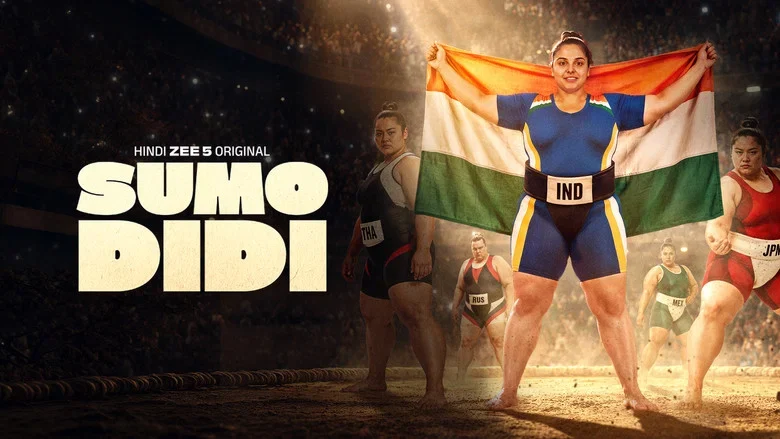
The first body we see Hetal Dave throw is not an opponent’s. It is her own, and the film never quite decides whether that’s a triumph or a problem.
Jayant Rohatgi’s Zee5 original opens on a Taiwan ring, then rewinds nine months to a Kolkata kitchen where bitter-gourd juice is poured like a sentence.
A Victory We Watch Backwards, And The Cost Of That Rewind
Starting with the win is a defensible gamble. It tells us the destination before we’ve earned the map, and it turns the central question from whether Hetal will find her arena into how much it will cost her to get there.
But a sports biopic lives or dies on whether the destination feels earned in the muscles, not just the timeline. Here the rewind is efficient, occasionally elegant, and just as often a way of skipping the work.
Rohatgi keeps the camera close to domestic spaces, the kitchen counter, the yoga mat, the marriage conversation, and lets those rooms do the antagonising. That’s a canny instinct. It also means the ring has to fight the living room for dramatic gravity, and it doesn’t always win.

When The Mother Is The Whole Antagonist, Restraint Becomes A Risk
Anubha Fatehpuriya’s Sudha is the film’s engine of opposition, and she is written with real intelligence: not a monster, but a woman doing arithmetic on her daughter’s marriageability with the grim efficiency of a household budget.
Watch her hands. She measures, pours, suggests liposuction in the same tone she might suggest a tutor. That flatness is the performance’s sharpest weapon, and it makes the body-shaming land as routine rather than theatrical.
The trouble is structural. Koimoi’s framing, a sports biopic that doesn’t need a villain, is generous and true, but a distributed antagonist is a diffuse one. Ridicule, PCOD, infrastructure gaps and internalised shame all press on Hetal, and none of them get a scene with the sustained pressure that a single human opponent would.
Nitesh Pandey’s Rajendra is the counterweight, and he gets the film’s cleanest dramatic transaction: after Hetal strikes a neighbour who insults her, he redirects the fury into judo rather than punishing it. It’s a small, precise piece of parenting, and Pandey plays it without a single drop of sentiment.
The Body As Instrument, And The Performance That Makes It Legible
Shriyam Bhagnani’s physical commitment is the reason to watch. In the ring she uses weight and balance as technique, a low centre, a planted base, a shove that travels from the heels, and the transformation reads as athletic rather than cosmetic.
Outside the ring she plays Hetal’s shame as a kind of posture: shoulders folded, eyes sliding away from mirrors and mothers alike. The gap between that stance and her squared-up ring presence is the film’s real arc.
It’s a performance that recalls the grounded, unglamorous physicality of the work in Udumbanchola Vision, where the body carried the argument the dialogue couldn’t. Bhagnani is doing something similar, and doing it well.
Chaitanya Sharma’s Akshat, the physiotherapist and closest ally, is given the least rewarding job in the script: he exists to say the encouraging thing at the low point. Sharma plays him warmly, but the character is a function, not a person.
Where The Sports Machinery Sputters
The competition material is where the film’s sincerity runs out of road. NewsBytes called it a sincere but ineffective sports biopic, and that verdict holds up in the arena scenes, which are staged competently but cut without escalation.
There’s no rhythm of near-loss and recovery, no opponent who gets a face and a grudge. The Taiwan match arrives as a known quantity rather than a crescendo, and the training montages substitute endurance for jeopardy.
The judo sequence is the exception, and it’s instructive. It works because it has a clear cause, humiliation, and a clear physical consequence. The sumo bouts rarely have that causal clarity.
Rohatgi’s restraint, which serves the domestic drama so well, becomes a liability in the ring. The film trusts its star’s body to carry the climax, and Bhagnani nearly does, but nearly isn’t a pin.
A Familiar Inspirational Skeleton, Dressed In Unfamiliar Clothes
The screenplay, credited to Nikhil Sachan from a story by Sachan, Akash Chawla and Arunava Joy Sengupta, fictionalises Hetal Dave’s life with reasonable licence and no obvious holes. What it lacks is friction between beats.
Childhood mockery, parental resistance, discovery, training, international recognition, the stations are all present and all visited on schedule. The novelty is the sport and the body politics; the architecture is the standard-issue inspirational biopic.
That’s not fatal. It is, however, why the film’s social material consistently outshines its sporting material: the former has texture, the latter has template.
The film’s genuine contribution is the way it makes Hetal’s build narratively functional, the same body ridiculed at the dinner table becomes an athletic resource in the ring. That’s a sharper idea than most sports dramas attempt, and it deserves a climax with more teeth than this one gets.
Seen alongside the patient procedural discipline of Gajab Raat, the contrast is instructive: that film knows exactly what its central tension is and never lets go of it, while this one keeps its grip loose.
The Streaming Calculus, And What Zee5 Gets For Its Money
Sumo Didi arrives as a Zee5 original rather than a theatrical proposition, which changes the commercial question entirely. There are no opening-day collections to parse, no exhibitor share to defend, no weekend multiplier to sweat.
What Zee5 is buying here is prestige-adjacent, women-led, socially engaged content, a category the platform has been building deliberately. On that ledger, the film is a defensible acquisition: it’s earnest, it’s anchored by a committed lead performance, and it has a real-life hook that travels well in thumbnails.
What it isn’t is a subscriber magnet on the scale of a franchise title. The film’s theatrical leverage is essentially nil by design, and Bhagnani’s box-office value remains unproven because this release never tested it.
For the wider ecosystem, this is the familiar streaming-era bargain: a story too niche for a wide theatrical push gets made at a smaller scale, with a smaller promotional footprint, and a first-time lead carrying the weight. That trade-off is visible in the film’s production values, particularly in the competition staging.
The broader shift toward character-led, socially grounded drama across contemporary Hindi dramas is real, and Sumo Didi is a legitimate part of it. It just isn’t the strongest argument for it.
The Pin That Doesn’t Quite Land
The ending frames Hetal’s recognition as the creation of a professional path rather than a family reconciliation, which is the right instinct. It refuses to let Sudha’s approval be the prize, and that refusal is the film’s most quietly radical move.
But the climax resolves through competitive performance without ever making that performance feel like a battle. We watch Hetal win the way we watch someone complete a task they were always going to complete.
The film’s philosophical claim, that a body treated as a liability can become the foundation of an identity, is genuinely worth making, and Bhagnani makes it with her stance, her weight, her refusal to shrink. That’s the residue that lingers.
What lingers less is the film around her: sincere, well-intentioned, and too polite to ever really throw its weight. It’s a biopic that steps into the ring and then spends most of its time apologising for being there.
Thematic siblings like Poniiy share the same flaw, a strong central idea that the execution never quite dares to squeeze, and the comparison doesn’t flatter either film.
Sumo Didi is worth your evening for the performance and the politics. It is not, ultimately, a film that wins by throwing its opponent to the ground; it wins on points, and narrowly.

Recommended for You

THE BRANDOS (2026): A Phantom Release That Never Was + A Void Where Cinema Should Be
The ticket stub in my pocket says “The Brandos, ” but the screen that flickered to life at the 7:40 show carried…

Arulvaan (2026): Arulnithi anchors a sincere but uneven rural drama
There is a scene early in Arulvaan where Arulnithi’s character watches his daughter (Krithika Balasubramanian) trace alphabets on a dusty slate, her…
HALF (2026): and the Missing Pieces
Half opens on snow, not fangs. Somewhere in Europe, a vampire named Victor falls for a human woman, Sofia, and the hunters…