O.M: Operation Mole (2026): Dhanush and Mammootty’s Spy Thriller Buries Its Tension in Temple Corridors


The first thing Rajkumar Periasamy shows us is a corridor, lamp-lit, narrow, and watched from both ends. By the time the second reel unspools, that corridor has become the film’s entire thesis.
An Undercover Agent Who Never Quite Disappears Into His Cover
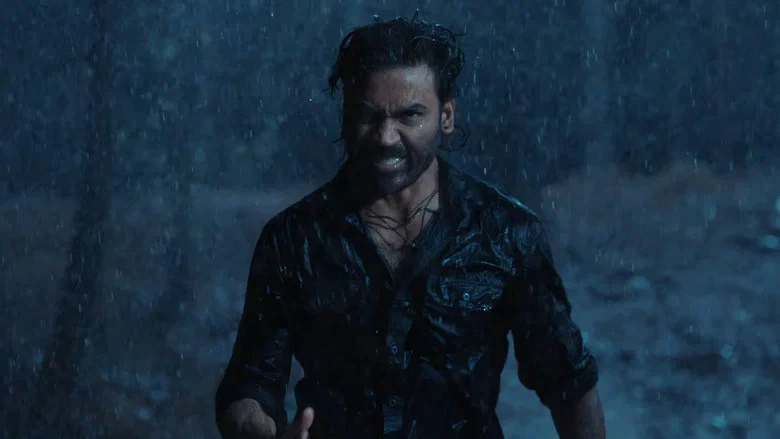
Dhanush plays Pazhanivel, a man carrying three names: his own, the state designation D-402, and the civilian mask Thirukumaran. The premise is a red-sanders syndicate operating through Tirupati and Tiruvannamalai, and a mole planted deep inside it.
That triple identity should be the engine of every scene. Instead, the film treats it as a label, a fact we are told, then asked to admire rather than feel.
The setting is genuinely novel. Red sandalwood smuggling through temple towns gives the crime network a geography that isn’t Mumbai docks or Chennai warehouses, and Periasamy shoots those stone passages with an awareness that surveillance is always two bodies deep.
Mammootty’s Criminal Kingpin Is All Stillness and Withheld Volume
Burma “Siya” Karthikeyan enters late and low, seated while others stand, his voice dropped to a register that forces the room to lean in. Mammootty understands that authority is a matter of who can afford to speak quietly.
The problem is structural. Karthikeyan is written as an obstacle rather than an antagonist, a wall Pazhanivel must climb, not a mind he must out-think. When the two finally share extended screen time, the film briefly crackles, then cuts away.
Periasamy’s earlier work in Sooriyan Maraindha Maalai showed a filmmaker willing to let dread accumulate without explanation. Here, the accumulation keeps getting interrupted by plot.

Sai Pallavi Holds the Institutional Line, But the Script Won’t Let Her Cross It
As ASP Nithya Reddy, Sai Pallavi plays the task-force anchor with a clipped, procedural efficiency, signing files, holding eye contact a beat too long, never raising her voice. It’s a performance of controlled withholding.
The restraint is familiar from her work in Ramayana, where stillness carried mythological weight. Here it carries institutional weight, and the screenplay never gives her a scene where the two collide.
Sreeleela’s Roja, the wife who doesn’t know her husband’s real name, gets maybe four scenes. Each one is a domestic interruption the film treats as obligation rather than counterpoint.
What the Mole Structure Gets Right, and Where It Goes Soft
The middle stretch works best when it trusts silence. A handoff in a temple queue, a coded glance across a courtyard, a phone left face-down on a table, these are the moments where the espionage premise earns its keep.
Then the task force convenes, the mission is restated, and the film exhales. Every time the procedural machinery kicks in, the tension leaks out of the room.
The genre sibling here is instructive. Black Gold understood that a crime thriller lives or dies on the friction between the hunter and the hunted occupying the same frame. Operation Mole keeps separating them.
The Camera Knows What the Script Forgets
Cinematographically, this is a film of doorways and thresholds. Characters are constantly framed at the edge of a room, half in shadow, as if the lens itself is uncertain whether they’ve been made.
The score, by contrast, never trusts that. It swells on cue, announces every reversal, and undercuts the very ambiguity the framing is working to build.
Editing in the first half is patient, almost languid. The second half accelerates into a rhythm that feels imposed rather than earned, as if the film remembered it had a runtime to hit.
Wunderbar and RTake Are Betting on a Two-Star Collision That the Script Won’t Fully Deliver
Wunderbar Films and RTake Studios are mounting this as a prestige Tamil spy thriller, and the economics are legible: a Dhanush-Mammootty pairing is a theatrical event in a market that has grown suspicious of event cinema.
The pre-sales tell a story of anticipation, not certainty. What the film needs is word-of-mouth from the mass audience that shows up for the two leads, not the cinephile audience that will notice the structural gaps.
Across contemporary Tamil thrillers, the pattern is consistent: stars open the film, but structure determines whether it holds. This one opens strong and holds unevenly.
The Ending Resolves the Mission and Dodges the Question
When the operation finally closes, the film delivers the necessary beats, the cartel fractures, the mole survives, the state claims its victory. What it doesn’t deliver is the cost.
Pazhanivel walks out of the frame with his cover intact and his marriage unexamined. The film has spent two hours asking whether a man can be three people at once, and then declines to answer.
That evasion is the film’s truest flaw. Not the pacing, not the underused supporting cast, but the refusal to sit in the discomfort its own premise created.
Periasamy has made a competent, watchable, occasionally arresting thriller. What he hasn’t made is the film his corridor promised, the one where every doorway is a decision, and every decision costs something.
Explore Cinema Hubs

Recommended for You

Qaid (2026): Dhruv Jain s lands hard though the screenplay stays patchy
There is a moment in Qaid where Dhruv Jain simply sits still, and the camera refuses to blink. The film trusts that…

Sooriyan Maraindha Maalai (2026): Sacchin Nachiappan and a Blackout That Refuses to Become Drama
The lights go out across a Chennai apartment block, and two strangers are left on a terrace with nothing but each other…

Charitha Kamakshi (2026): A Quiet Telugu Romance That Earns Its Softness
A young bride steps into a filmmaker’s world, wide-eyed and adjusting, only to watch that world collapse when her husband’s moral compromises…