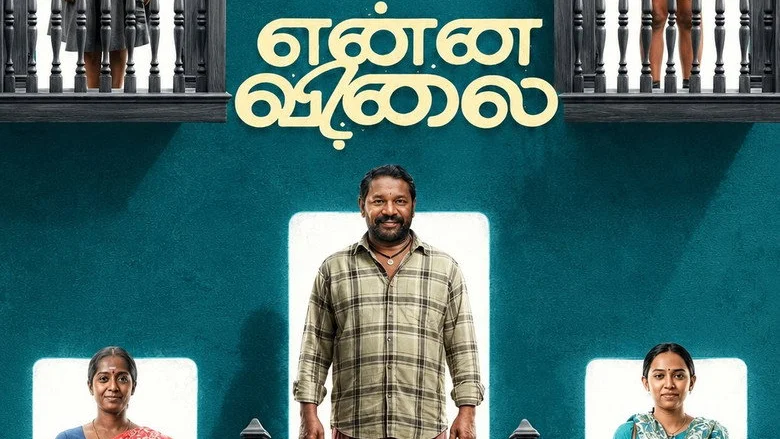
Enna Vilai (2026): A Fisherman, a Gold Pendant, and the Quiet Machinery of Injustice


The first image that sells Enna Vilai is almost insultingly simple: a coin sinking through green water, caught between a devotee’s fingers and the seabed. Thavasi, a Rameswaram fisherman, makes his living diving for exactly that, the loose change pilgrims toss into the sea as offerings, which he retrieves and converts into rice, rent, and school fees. Sajeev Pazhoor, making his directorial debut after writing Thondimuthalum Driksakshiyum, builds his entire moral architecture on this single, unglamorous transaction. Faith drops wealth into the water. Poverty fishes it back out. Nobody in the chain is doing anything wrong, and yet the whole arrangement sits on the edge of a knife.
Then the sea coughs up a gold pendant, and the knife turns.
The Blessing That Becomes a Charge Sheet
Pazhoor’s screenplay, which took Best Screenplay at the Dadasaheb Phalke International Film Festival and Best Feature Film at the Mannheim Arts and Film Festival, is linear by design, moving from livelihood to accusation to courtroom with the patience of someone who has watched real cases grind through real courts. The pendant initially reads as providence. Within the logic of the film, that’s the trap. A man with nothing suddenly holding something is not lucky; he is suspicious. The false accusations that follow aren’t framed as a twist but as an inevitability, the system doing what systems do when the poor reach slightly above their station.
What elevates this above standard issue-drama territory is the specificity of the trade. This isn’t a generic “poor man wronged” template, it’s a livelihood so particular, so rooted in the ritual economy of Rameswaram, that the injustice acquires texture. The coins aren’t just money; they’re the residue of other people’s prayers. Thavasi’s dignity is bound up in handling something sacred and profane at once, and the film never lets you forget the queasy intimacy of that job.
Karunaas at Twenty-Five Years, and the Weight of Stillness
The casting of Karunaas as Thavasi is the film’s smartest decision and, per pre-release coverage, its most personally loaded, this marks his twenty-fifth year in cinema, and reports note he connected with the story immediately during the narration stage. What’s striking in the available material is the emphasis on his performance being “extraordinary despite limited combination scenes” with co-star Nimisha Sajayan. That’s a telling detail. It suggests a film that doesn’t lean on actorly sparring or big confrontations, but on solitary endurance, a man carrying the story largely alone, in silence, against institutions rather than individuals.
Nimisha Sajayan’s Kanchana was reportedly chosen by the actress herself after Pazhoor offered her a choice between two characters, and she responded emotionally to the casting. That kind of self-selection usually signals an actor spotting an arc with real interiority rather than screen-time volume. Shasha Shivakumar, meanwhile, prepared extensively for the rural role of Manimegalai, her first of this kind, and Vijayalakshmi’s character has been flagged in early material as “hard-hitting.” The ensemble is deep (Y. Gee Mahendran, Poornima Bhagyaraj, Nizhalgal Ravi, Mottai Rajendran, a small army of supporting players), which fits a film that wants to render a whole coastal community rather than a single martyr.
Worth noting for the trade-minded reader: the antagonist is not identified in any available source. In a courtroom drama, that’s either a deliberate structural choice, the system is the defendant, or a gap in how the film has been positioned. We’ll reserve judgment, but it’s an unusual omission for a genre that usually sells you a face to hate. For a contrast in how star-weighted ensembles can overwhelm their own thesis, see our take on Last Man verdict, where the building itself becomes the antagonist and the human villain almost incidental.
Fifty-Six Locations, One Register
Cinematographer Alby Antony shot across fifty-six locations in Rameswaram, Chennai, Puducherry, and Kochi, a logistical footprint that suggests Pazhoor wanted geography to do thematic work. Salt, humidity, temple towns, courtroom corridors: the visual argument is that Thavasi’s world and the world judging him are physically contiguous, separated by paperwork rather than distance. Sam C.S.’s score and the first single “Kadaladum, ” sung by Antony Daasan, lean into that coastal register. The audio rights going to G.V. Prakash’s label signals a film aware it needs a musical hook to travel beyond festival circuits.
The U/A certificate is its own small absurdity. Pazhoor reportedly requested a U and expressed surprise at the U/A, noting the film contains no objectionable content, no alcohol consumption, nothing of the sort. A film about a fisherman being crushed by false accusation, denied the cleanest possible rating for reasons the director himself can’t identify, is almost too on-the-nose. The censorship apparatus has effectively become a minor character in its own marketing.
What the Festival Run Actually Tells Us
Two awards, Mannheim and Dadasaheb Phalke, plus a Netflix acquisition that producers have nonetheless deprioritized in favor of a theatrical push. That last detail matters. On a reported budget of roughly ₹7 crore, this is a film betting that class and family audiences will show up in theaters for a socio-political drama with no identified villain and a lead actor carrying long stretches alone. That’s a real gamble in the current market, and it’s the kind of bet Epic First review also made in its own register, trusting that patient, character-rooted storytelling can hold a room.
The honest caveat: we have no verified critic scores, no IMDb aggregate, no audience sentiment percentages, and no box office figures at the time of writing. The praise we can cite is real but pre-formed, festival juries and premiere reactions, not the grind of general release. The film’s thesis, that dignity has a price and the poor pay it in installments, is legible from the premise alone. Whether Pazhoor’s execution sustains it across 124 minutes without tipping into sermon is the question only a full theatrical audience can answer.
Verdict
Enna Vilai arrives with the credentials of a serious film and the structural risk profile of one: no clear antagonist, a solitary lead performance, a courtroom third act, and a director trading his acclaimed screenwriting chair for the director’s chair for the first time. The Rameswaram specificity is its greatest asset, this is not a generic injustice narrative but one welded to a particular way of surviving by the sea. If Pazhoor’s script retains the observational discipline he brought to Thondimuthalum Driksakshiyum, this could be one of the year’s most quietly devastating Tamil releases. If it doesn’t, the festival garlands will look like a consolation prize.
Who should watch: Class and family audiences, festival-drama devotees, and anyone who values regional specificity over spectacle. Theatrical is the intended format, the producers have said so, and the location work justifies it.
Who should skip: Viewers needing a clear villain, brisk pacing, or star-vehicle energy. This is a slow-burn dignity drama, not a crowd-pleaser.
Rating: ★★★☆☆ (3/5), A promising, socially grounded debut with genuine craft and a career-best showcase for Karunaas, held back (pending full release) by an unverified critical consensus and a structure that risks solemnity over momentum.
Ankit Jaiswal is the Chief Author, covering Indian cinema and OTT releases with honest, no-filler criticism. An SEO strategist by background, he brings a research-driven approach to film writing, cutting through hype to tell you exactly what's worth your time.