Angelina (2026): Vinoth Kishan Anchors A Lean Two-Timer That Runs Out Of Clock

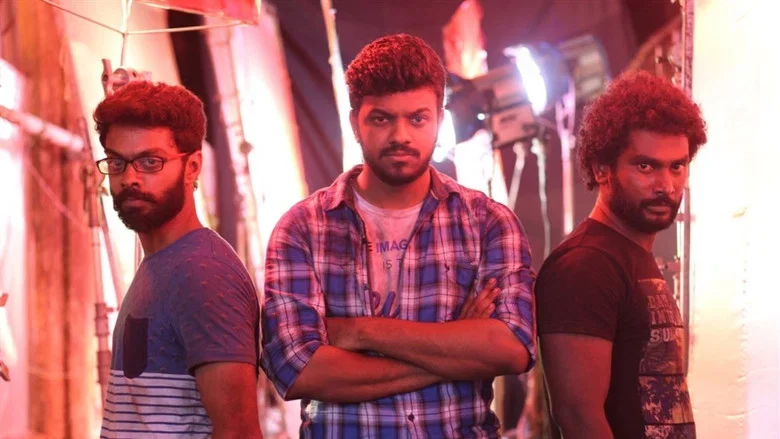
Angelina hands a man six months to win her heart, then spends the back half of the film unconscious while the police race a twenty-four-hour clock to find who broke her. That inversion is either the year’s cleanest structural gamble or its most evasive piece of screenwriting.
At a hundred and one minutes, this is a film that trusts brevity. What it does with that brevity is the argument.
The Six-Month Courtship That Becomes A Twenty-Four-Hour Countdown
The opening movement is all negotiation. Angelina, a college student with a streak of theatrical control, sets the terms of her own wooing and makes a game of it, and the film briefly sells the pleasure of watching someone dictate the rhythm of her own romance.
Then the body drops. Or rather, hers does, and the film pivots hard from flirtation to forensic urgency, with the people who once orbited her affection now sitting across an interrogation table.
It is a genuinely elegant hinge on paper. The trouble is that the hinge is doing more work than the door.
When Everyone Is A Suspect, Nobody Is A Character
Once Angelina is down, the film inherits the classic ensemble-mystery problem: a suspect pool built from trusted acquaintances needs each of them to carry a distinct, visible motive. Here, the circle blurs into a texture rather than a gallery of specific hungers.
The screenplay treats proximity as guilt and lets suspicion do the characterization. That is efficient. It is also strangely bloodless, because we never quite learn what any of these people wanted badly enough to destroy her.
An investigative drama lives or dies on the specificity of its red herrings. This one trades specificity for speed, and the speed starts to feel like avoidance.
Vinoth Kishan’s Stillness, And The Silence Around It
Vinoth Kishan carries the heaviest load, and he does it largely in the register of withheld reaction. Watch his hands in the interview sequences: the way they stay flat on the table while his jaw works, the way he answers a question with a half-second delay that reads as calculation rather than confusion.
It is a performance of controlled surfaces, and it is the film’s most disciplined element. The restrained physical exhaustion he brings here recalls the psychological weight of his turn in Lakadbaggha 2, where he similarly let silence do the threatening.
Monica Chinnakotla gets the showier assignment, all spark and provocation in the courtship stretch, and she is genuinely magnetic when the film lets her be a person rather than a case file. The tragedy is how quickly she becomes evidence.
A Director Who Knows The Clock But Not The Room
The filmmaking is functional in the best and worst sense: the camera stays close, the rooms stay tight, and the score pushes urgency whenever the writing stalls. There is an overreliance on the ticking-clock cue, as though the audience needs reminding that twenty-four hours is not a long time.
Where the direction genuinely works is in the interrogation geography. Suspects are seated at angles rather than across from each other, so the eyelines keep breaking, and the frame keeps reminding us that trust is a spatial arrangement that has collapsed.
Where it fails is in the romantic half. The six-month courtship is staged with sitcom brightness and no real friction, so the pivot to darkness lands as a genre switch rather than a betrayal.
The Remake Economy And What A Small Film Is Actually Betting On
This is the kind of mid-budget Tamil drama that lives or dies on word-of-mouth within its first weekend, and its commercial math is unforgiving. There is no star-vehicle cushion here, no franchise scaffolding, and no spectacle to justify premium pricing.
The producing muscle behind it is modest, and the release slate around it is crowded with bigger, louder titles fighting for the same screens. A hundred-and-one-minute runtime helps with show count. It does not help with the fact that the film has no obvious hook to sell beyond its premise.
Vinoth Kishan’s theatrical leverage is real but narrow. He is a character actor with a growing reputation and no mass-opening muscle, which means this film’s ceiling is set by how fast the mystery crowd talks.
If the ending lands, the film has a second-week life. If it doesn’t, this is a one-weekend proposition, and everyone involved knows it.
The Verdict: A Clever Frame Around A Hollow Core
Angelina is a film built on a genuinely smart structural idea, executed with a discipline that occasionally mistakes terseness for depth. The romance half is too light to wound, and the investigation half is too fast to interrogate anyone properly.
What saves it from being a shrug is the central performance and the honesty of its central question: how quickly does love become suspicion when the person you trusted stops being able to speak for herself?
The film never quite answers that. It just runs out the clock, and leaves you wondering whether the real mystery was the crime or the woman who set it all in motion.
For a certain strain of contemporary Tamil dramas, that ambiguity is the point. Here, it reads more like a door left politely ajar.
Explore Cinema Hubs

Recommended for You

Uttar Da Puttar (2026): A Gentle Satire That Prefers Warmth Over Bite
Annu Kapoor leads this ensemble with the kind of heartfelt ease that has become his signature. His Professor isn’t a loud caricature;…
Soulmates – Oru Saathukkudi Pranayam (2026): Nivin Pauly Anchors Meta-Romance That Plays Too Safe
Joel Davis walks into the frame of a film that is not quite his own, pitching a short film about a mosambi,…

Epic – First Semester (2026): Hesham Abdul Wahab’s Melodies Outlast the Drift
A phone call home from a cramped London flat, a mother’s voice thinning into static while her son counts pounds he does…