Drones (2026): Dravid Selvam Anchors a Tamil Surrealist Fantasy That Refuses to Sit Still

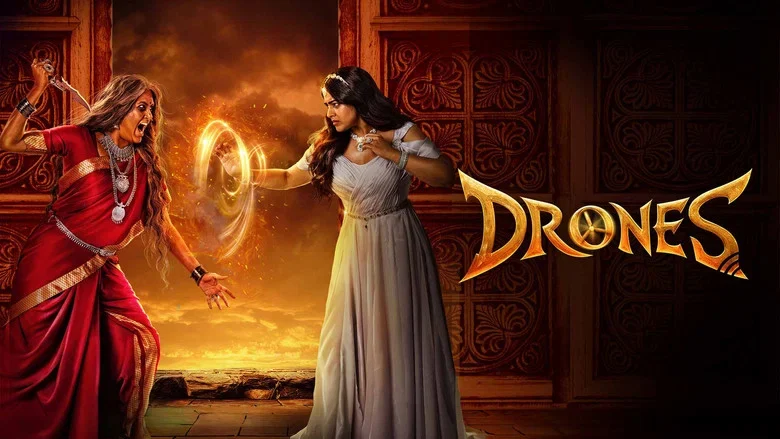
A drone hovers over an old mansion, piloted by a suspended astrophysics student who has no idea he is about to fall through a window into someone else’s dream. R. Raghav Mirdath’s Drones opens on a surveillance gag and ends up arguing about beauty, loneliness, and the violence of the male gaze.
When a Drone Hijacking Becomes a Haunted Mansion Confession
The first act moves briskly through a suspension, a locked-down scientist’s house called the “Black Hole, ” and a hijacked drone named Sampangi. Kish, played by Dravid Selvam, points the machine across town and finds Prakruthi, a miniature artist framed in a window like a painting he wants to own.
Mirdath shoots that discovery as a technological act of trespass, not romance. The drone’s remote eye does the work of a peeping tom while the film pretends it is science fiction, and that tension is the point.
The early comic rhythm belongs to the student trio, whose banter keeps the eccentric premise grounded. Selvam’s Kish is a boy who mistakes curiosity for destiny, and the actor lets that blindness sit plainly on his face during the drone sequences.
The Courtship Ritual That Repeats Until It Becomes a Diagnosis
Men who meet Prakruthi cycle through the same ritual: poems, dolls, rings, and promises to love her when her hair turns white. The repetition is deliberate, and it exposes the mechanical quality of instant attraction better than any monologue could.
Patience is required. The gag holds only as long as the viewer tolerates the pattern, and the middle stretch stacks a sleepwalking student, a bride-hunting Inspector, and a made-to-order girlfriend experiment on top of it. Mirdath keeps adding rooms without always showing the exit.
A supporting performer like Devadarshini, as the witch tied to the mansion, earns her scenes by balancing menace with comic timing. She does not play the threat as a monster; she plays it as someone who has watched this performance before.
That control is missing from some of the surrounding machinery. The Inspector thread, built around a palmist’s warning that any woman he sincerely tells “I love you” will die, works as a sketch but not as a spine.
The film’s structural ambition is closer in spirit to the uneven genre experiments dissected in Poniiy, where a strong premise strains against a screenplay that cannot decide what to do with its own invention.
Anjali Nair Turns the Witch Confrontation Into the Film’s Real Climax
Anjali Nair’s Rush carries the emotional counterweight. She has loved Kish quietly while he stares at a woman who exists for him only as a surface, and Nair plays the neglect without pleading for the audience’s sympathy.
Her confrontation with the witch is the sequence the entire film has been building toward. Rush speaks about the harm caused by narrow beauty standards, and the scene works because Nair keeps her voice low and steady rather than turning the speech into a declaration.
The staging matters. Rush stands close enough to the witch that the exchange feels like an argument between two people rather than a heroine lecturing a monster, and the supernatural frame collapses into something painfully human.
Selvam’s work elsewhere in the film does not reach that register. His comic timing is serviceable, but Kish’s romantic self-deception is played broadly, and the actor’s more textured instincts in Once More suggest he is capable of more interiority than this role asks for.
Siddhi Idnani’s Prakruthi is limited by design. The character must appear angelic so that men can project onto her, and Idnani delivers exactly that, but the screenplay never gives her a private moment to complicate the image.
Mirdath’s Spatial Grammar: Science Fiction House Versus Storybook Mansion
The film’s visual logic rests on a clean opposition. The “Black Hole” is cramped, metallic, and ruled by experiment, while the old mansion is open, dim, and decorated like a fairy tale that has begun to rot.
Mirdath uses the drone as a bridge between those spaces, and the device’s floating perspective gives the film its most distinctive visual idea. When the camera adopts the drone’s view, the audience becomes a voyeur alongside Kish, implicated in the same act of looking.
The editing loses that discipline in the second half. As the witch, the doll transformations, and the romantic triangle converge, the film’s forward motion becomes unclear, and scenes begin to feel like they are waiting for the next eccentric character to arrive.
This is where the tonal tightrope snaps. The screenplay wants horror, comedy, romance, and social critique in the same frame, and the result is a film that is often charming but rarely controlled.
The genre blending recalls the ambitions, and the frustrations, of Afreet – A Never, another recent horror effort that struggles to make its supernatural mechanics carry the weight of its ideas.
What the Doll Transformations Actually Argue
The witch’s transformation of men into dolls is the film’s most legible metaphor. Men who treat women as decorative objects are converted into decorative objects themselves, and the punishment fits the crime with a bluntness that is almost admirable.
But the metaphor only lands because Rush’s confrontation gives it a voice. Without that scene, the doll imagery would be a visual gag; with it, the horror becomes a verdict on the way the men around Prakruthi have behaved.
The film’s kindness is that it does not exempt Kish from that verdict. He is not a villain, just a boy who looked at the wrong thing for too long, and the ending’s emotional logic depends on him understanding the difference between wanting someone and seeing them.
That argument places Drones within a broader movement in contemporary Tamil horrors that use supernatural frameworks to examine social prejudice rather than simply delivering scares.
GM Morgan Films and the Economics of the Mid-Budget Genre Gamble
GM Morgan Films is betting on a premise that does not fit neatly into the market’s usual categories. A Tamil surrealist fantasy with a witch, a drone, and a beauty-standard critique is not an easy sell, and the film’s commercial life will depend on word of mouth rather than franchise recognition.
Dravid Selvam’s box-office leverage remains modest, and the film’s theatrical ceiling is limited by its refusal to commit to a single genre. The upside is that the audience it does find will be loyal, and the film’s thematic clarity gives it a longer shelf life than a conventional horror release.
The real financial question is whether GM Morgan Films can turn an eccentric premise into a repeatable model. Drones suggests the banner is willing to take risks that larger studios avoid, but the film’s crowded middle act is a warning about the cost of that ambition.
The Uncomfortable Resolution and the Limits of Looking
Drones ends by privileging character over appearance, and the resolution is earned because Rush’s confrontation has already done the argumentative work. The film does not pretend that Kish’s change of heart is easy, only that it is necessary.
What lingers is not the witch or the drone but the image of a woman being looked at by a man who has not yet learned to see her. Mirdath’s film is messy, overstuffed, and occasionally unsure of its own escape route, but it knows exactly what it wants to say about the violence of superficial desire.
The result is a Tamil fantasy that trusts its audience to follow a strange premise into uncomfortable territory. It is not a clean film, but it is a film with a point, and that point lands hardest when Anjali Nair’s Rush finally speaks it aloud.

Recommended for You
Vishwanath & Sons (2026): Suriya’s Tender Drama of Duty, Love, and Fatherhood
Sanjay Vishwanath is an international shooter whose world is measured in precise distances and controlled breathing, yet the film finds him helpless…
Chevittorma (2026): Dileesh Pothan Anchors a Deathbed Vigil That Refuses to Expire
The whisper arrives before the man does. In the opening stretch of Chevittorma, Pauly Valsan’s Theresia leans over a stranger’s bed in…

Sarvagunn Sampann (2026): Vaani Kapoor’s Identity Comedy Is a Curious Oddity
The teaser’s defining image is unmistakable: Vaani Kapoor split across two looks, one demure and one dangerously close to a public fantasy,…