Father’s Day (2026): A Kannada father-son road drama stuck in neutral

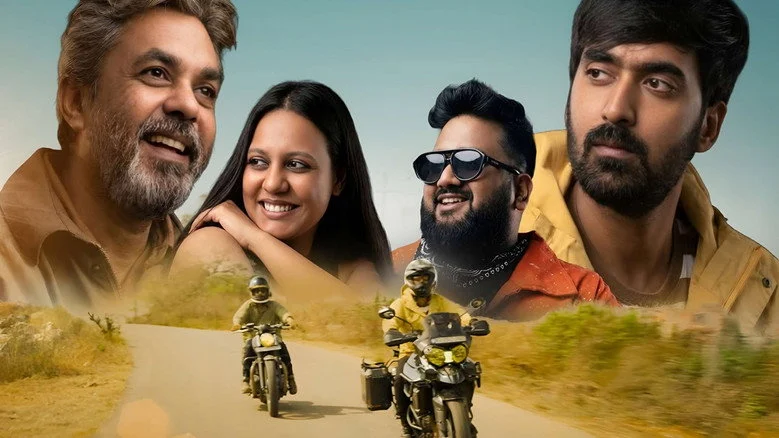
The reveal lands early: Sushant, on the verge of becoming a father himself, learns his estranged father is alive. It is a quiet gut-punch, and Harshil Koushik registers it with a stillness that suggests years of buried resentment rather than melodramatic shock.
Koushik’s performance is the film’s most reliable asset. He plays Sushant as a man caught between two versions of fatherhood, the one he’s about to enter and the one he never truly had. His restraint in the reflective road passages gives the film its emotional spine, even when the script around him falters.
One specific exchange, where Sushant confronts his father over unresolved history, carries genuine warmth because Koushik refuses to oversell the pain. He lets the silences do the work. It is grounded, mature work that elevates material that might otherwise feel thin.
Rajaram Rajendran’s direction: restrained vision, muddled middle
Rajaram Rajendran, who also wrote and produced, clearly understands the nuance of father-son dynamics. His treatment of fatherhood is refreshingly imperfect, no sainthood, no villainy, just complicated human beings trying to find a way back to each other.
The flaw is structural. The road-story framework, meant to externalize Sushant’s internal conflict, loses direction in the middle act. What should feel like progress turns static, and the journey begins to spin its wheels instead of moving forward.
Rajendran’s strength is emotional restraint; his weakness is narrative momentum. One review put it bluntly: the film “ends up spinning its wheels.” I would add that the payoff, when it finally arrives, feels earned but underwhelming, a whimper where a cathartic release was needed.
The genre-core: a drama that forgets to escalate
As a drama, Father’s Day is built on relational tension rather than plot-driven escalation. The conflict is internal and familial, with no traditional antagonist to sharpen the stakes. That choice is admirable in theory, but it demands a screenplay that can sustain interest through conversation and subtext alone.
The middle section struggles with this burden. The pacing is uneven, and the reflective passages that critics praised as the emotional spine sometimes feel like padding. The road journey, which should reveal character through movement and encounter, instead settles into repetitive conversations that circle the same emotional ground.
Where the film succeeds is in its quieter moments. The father-son confrontation scenes, built on unresolved family history, are the strongest material here, grounded, warm, and honest. But the comedy and biker elements feel secondary, almost decorative, never integrating fully into the emotional core.
For more Kannada drama reviews, explore our Kannada Adventure reviews section.
Supporting cast: promising players, underwritten roles
Ajith Hande as Sudheer and Babu R. Alok as Anna are listed among the primary roles, but the gathered sources offer no specific commentary on their performances. That silence is telling, it suggests their characters exist more as functionaries of the road-journey structure than as fully realized people.
Samragni Rajan’s “Rider Girl” is an intriguing casting choice, a character who could have added texture to the biker-comedy angle. Yet without scene-level detail in the available criticism, she remains a promising presence rather than a memorable one. Arun Ramdas appears in a cameo, but his contribution is similarly undocumented.
The casting signals an intent to build a believable ensemble around Koushik, even if the screenplay doesn’t give them enough to do. This is a film where the lead shines, but the supporting players are left to orbit his emotional journey rather than complicate it.
Audience reception: a film for the patient, not the restless
Father’s Day is a film that knows exactly who it’s for, and who it isn’t. Fans of restrained, character-driven Kannada cinema will find much to admire in its emotional honesty. Viewers expecting commercial momentum, a villain-driven plot, or large-scale spectacle will likely check out before the halfway mark.
The criticisms are consistent across reviews: slow pacing in the middle, limited narrative payoff, and a story that may feel too restrained for genre-hungry audiences. The praise is equally consistent: heartfelt performances, grounded storytelling, and a mature handling of father-son dynamics.
One publication noted the film “successfully captures the nuance of father-son dynamics with maturity and warmth.” Another framed it as being “about the complicated, imperfect, and human idea of fatherhood.” Both are accurate, but they also describe a film that prioritizes atmosphere over incident.
If you found this analysis of father-son dynamics compelling, you might appreciate G D review, which shares a similar tension between strong performances and patchy screenwriting.
Father’s Day is a watch for those who value emotional restraint over narrative propulsion. Go in with patience, and you’ll find a sincere, well-acted drama about imperfect fatherhood. Go in expecting a biker-comedy, and you’ll leave disappointed. Regular format is fine; this is a film that lives in faces and silences, not spectacle.
Father’s Day (2026) earns a modest 2.5 out of 5, a heartfelt, well-acted drama that never quite finds its road.
For another take on regional storytelling that struggles with rhythm, see Oh Sukumari verdict.

Recommended for You
Picture (2026): Deepu s Village lifts key stretches, not the full runtime
The opening frames of Sandeep Bedra’s *Picture* show Deepu (Nithyaprakash Bantwal) packing a modest bag, leaving his village for the city’s promise…
Hushar Pittalu (2026): Bold Content Overshadows an Honest Youth Drama
The secret is out before the interval in Hushar Pittalu, two teenagers, Ravi and Chitti, are caught in a relationship their families…
Vo Ladki (2026): A Wristwatch, A Memory, And The Weight Of Letting Go
The last meeting arrives with a wristwatch as its only currency. Pathik walks toward Devyani not to reconcile, but to return an…