Batwara 1947 (2026): A Message of Harmony Buried Under Overwrought Drama

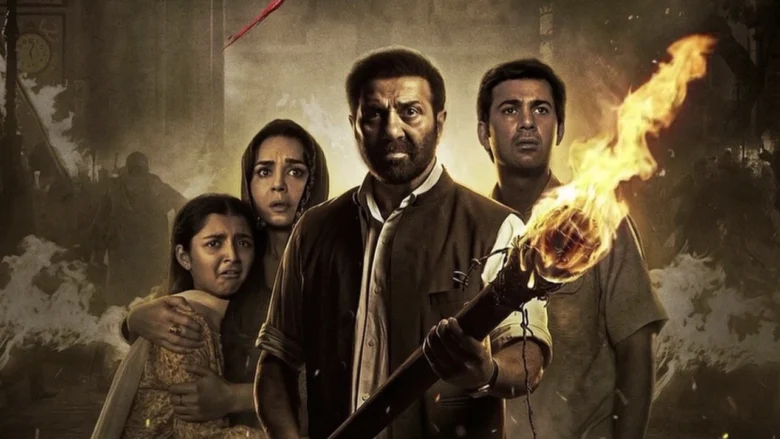
The first time Sikander Mirza’s refugee family steps into that Lahore haveli, they find an elderly Hindu widow already occupying the space, a moment of silent, loaded confrontation that sets the entire moral stage of Batwara 1947. It is the film’s sharpest image, a domestic collision that carries the weight of an entire subcontinent’s division, and for a brief while, it feels like Rajkumar Santoshi might pull off something genuinely restrained.
Sunny Deol’s Protection Act Feels Familiar but Effective
Sunny Deol operates squarely in his comfort zone here, and that is both the film’s strength and its limitation. His Sikander Mirza is built around physical authority and a protective moral core, most visible in the trailer-facing scene where he vows to shield a mother through the chaos of Partition.
The role demands moral force rather than tonal subtlety, and Deol delivers exactly that, no more, no less. His confrontation scenes carry a visceral weight that younger actors in the ensemble cannot match, even if the performance never surprises you.
Shabana Azmi Anchors the Haveli’s Emotional Gravity
Shabana Azmi’s presence transforms the shared-haveli premise into something genuinely affecting. Her exchanges with Deol inside that enclosed domestic space are the most frequently singled-out moments in the film, and rightly so, she brings a lived-in quality to the widow’s fear and dignity.
Without her, the film’s central coexistence theme would collapse into mere sloganeering. Azmi’s casting signals that Santoshi understood the emotional core of his story, even if his execution of it remains uneven throughout the runtime.
The Drama’s Core: A Household Under Siege
Batwara 1947 narrows Partition into a contained domestic conflict, which is its most intelligent structural choice. The haveli interior becomes a pressure cooker where communal violence is felt as external threat rather than constant battlefield spectacle, and the cinematography leans into those enclosed spaces to heighten the siege mentality.
Santoshi’s direction shows clear historical framing of Partition-era Lahore, and the interpersonal tension between the two households is handled with genuine care in the opening stretches. The premise of strangers forced into coexistence under threat is sharply defined and immediately urgent.
But the screenplay’s linear structure overextends itself in the later sections, leaning heavily on familiar emotional beats that dilute the impact of the film’s better moments. The message of harmony is repeated so earnestly that it begins to feel like a lecture rather than a lived dramatic truth, and the climactic passages suffer from that overwrought treatment.
One publication’s assessment cuts to the heart of it: “An earnest message of harmony gets an overwrought treatment.” That is the film’s central problem in a single sentence, and the Times of India’s average critic rating of 2.5 out of 5 reflects that tension between intention and execution.
Supporting Ensemble: Present but Underdeveloped
Preity Zinta and Ali Fazal are part of the central ensemble, though their roles remain frustratingly vague in execution. Zinta’s contribution sits within the family-and-displacement track rather than a separate subplot, while Fazal appears in a pivotal supporting capacity that the screenplay never fully defines.
Karan Deol is present as part of the refugee-family ensemble, and Abhimanyu Singh is listed in a key antagonistic role, but neither gets the scene-level development that would make their arcs land. The film’s supporting cast is a collection of solid performers waiting for a screenplay that gives them something specific to play.
Audience Fit and the Fine Line Between Earnest and Heavy-Handed
This is a film that will find its natural audience among Sunny Deol fans and viewers seeking family-and-history narratives. The Partition backdrop and Lahore setting were widely noted in early audience reactions, and the family-protection angle remains the strongest emotional hook available.
But the length is a genuine concern, at 2 hours 25 minutes, the pacing reportedly becomes strained as the film pushes toward its message-driven climax. The CBFC cleared the film without cuts, and no controversy has attached itself to the production, which is notable for a Partition drama in the current climate.
For viewers who dislike heavy-handed messaging or prolonged historical suffering on screen, this will be a difficult sit. The film’s earnestness is admirable in intent but becomes a liability in execution, and I found myself wishing Santoshi had trusted his actors and his premise more than his declarations.
If you are drawn to Partition dramas, this is worth a regular theater viewing for the Deol-Azmi exchanges alone. But temper your expectations, the film’s reach for profundity exceeds its grasp, leaving a well-intentioned but uneven experience that never quite earns its own emotional claims.
Batwara 1947 is a sincere film that mistakes volume for depth, and while its heart is in the right place, its craft falls short of its ambitions, a generous 2.5 out of 5.
For more Hindi Action reviews, explore our ongoing coverage of the season’s most talked-about releases.
If this theme of coexistence under pressure resonates, you might find Musafir Cafe review worth your time for its similarly earnest but uneven execution.
For a more restrained take on historical suffering, Souls Wind verdict offers the tonal control this film lacks.

Recommended for You
Once More (2026): Arjun Das Carries lifts key stretches, not the full runtime
Arjun Das, known for his intense turns, shifts gears as Raghu, a man still nursing a broken heart. His introduction establishes a…

Ottam Thullal (2026): A Rural Family Entertainer Banking on Ensemble Comfort
There is a certain comfort in the familiar rhythm of a Malayalam rural family entertainer, the kind that promises a village square,…

Pluto (2026): Adithyan Chandrashekar risks familiarity with alien-comedy formula
An extraterrestrial lands in a quiet Kerala village, and the local chaos machine revs up. This is a bet on ensemble charm…